Uncontrollability
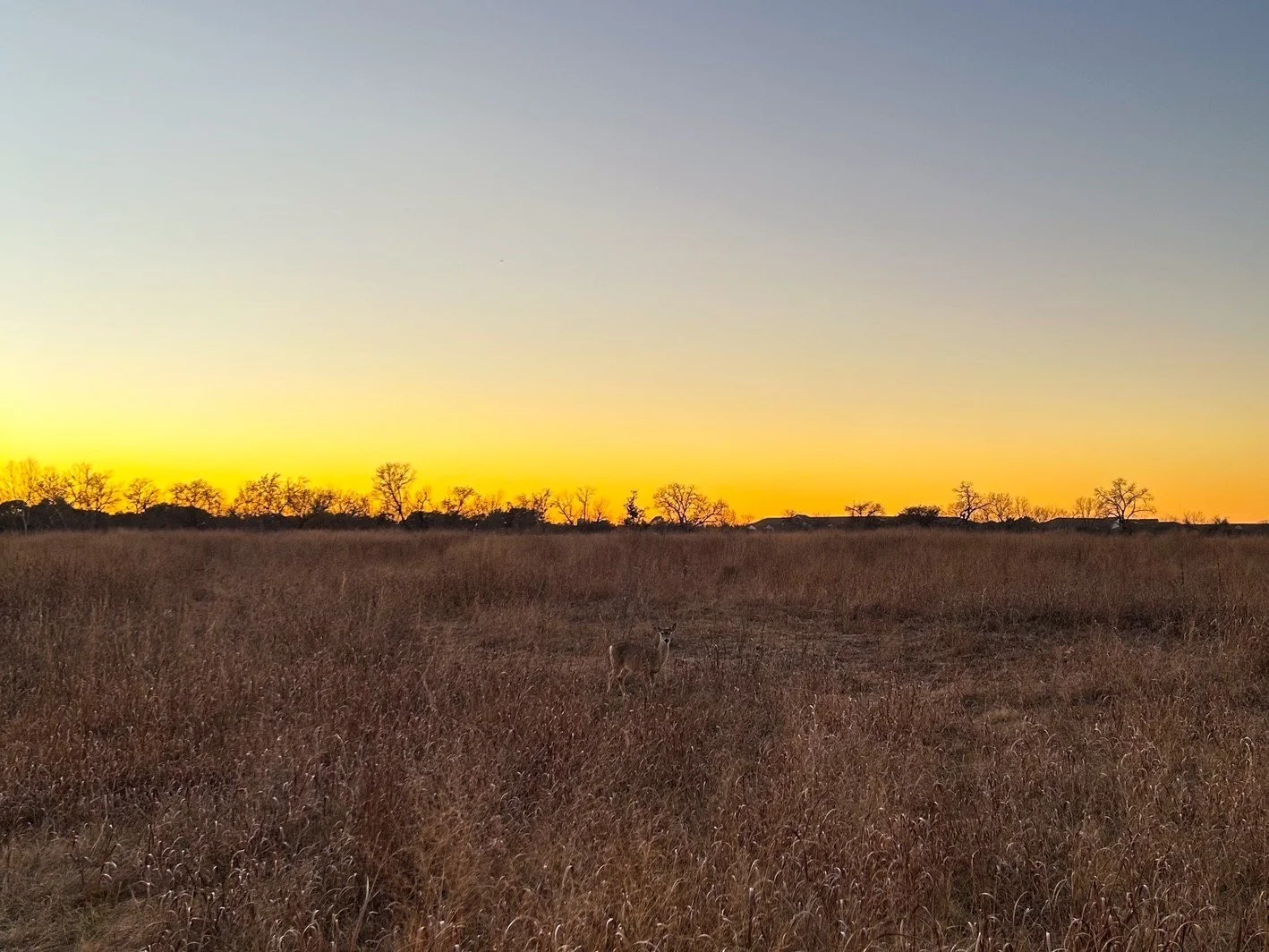
Three minutes after sunset on January 21, 2026, at the Cibolo Center for Conservation.
Maybe you’ve had this experience. Someone tells you about a book they’ve been reading, a book they can’t stop thinking about. They love the book so much, in fact, they’re going to buy you a copy and place it in your hands. You get the sense they’ve done this before. You get the sense they’ll do it again.
So much of what happens next depends on who you are, what season of life you’re in, and your general attitude about free books. A lot depends, as well, on what you make of the person doing the pushing.
Earlier this year, someone whose tastes and perspectives I’ve come to trust—and whose usual reticence to push much of anything on anyone made this exception all the more noteworthy—told me I needed to read The Uncontrollability of the World (Polity). I’d never heard of it. Nor, for that matter, was I familiar with its author, the German sociologist Hartmut Rosa.
Rosa, I’d soon learn, had earlier written a nearly six-hundred-page tome called Resonance: A Sociology of Our Relationship to the World, where he argues that in the face of modernity’s alienation and acceleration on a number of frightening fronts, the good life is to be found not in the pursuit of greater and greater control but in what he calls—you guessed it—“resonance.”
Simply picking up that doorstopper, as I have since done, and dipping into the occasional paragraph, is enough to trigger a migraine. So, no, I haven’t read that book just yet.
But I did make time for Rosa’s svelte—and, ostensibly, more accessible—sequel, the one I was given and encouraged to read by my wise, discerning friend. I can’t say I understood all of it. But neither have I been able to get it out of my mind. And not just because, as another friend pointed out, the cover image could easily be interpreted to portray a solitary figure in a blizzarded field, back turned to the nearby roadside, idling car waiting, perhaps, as he takes a leak.
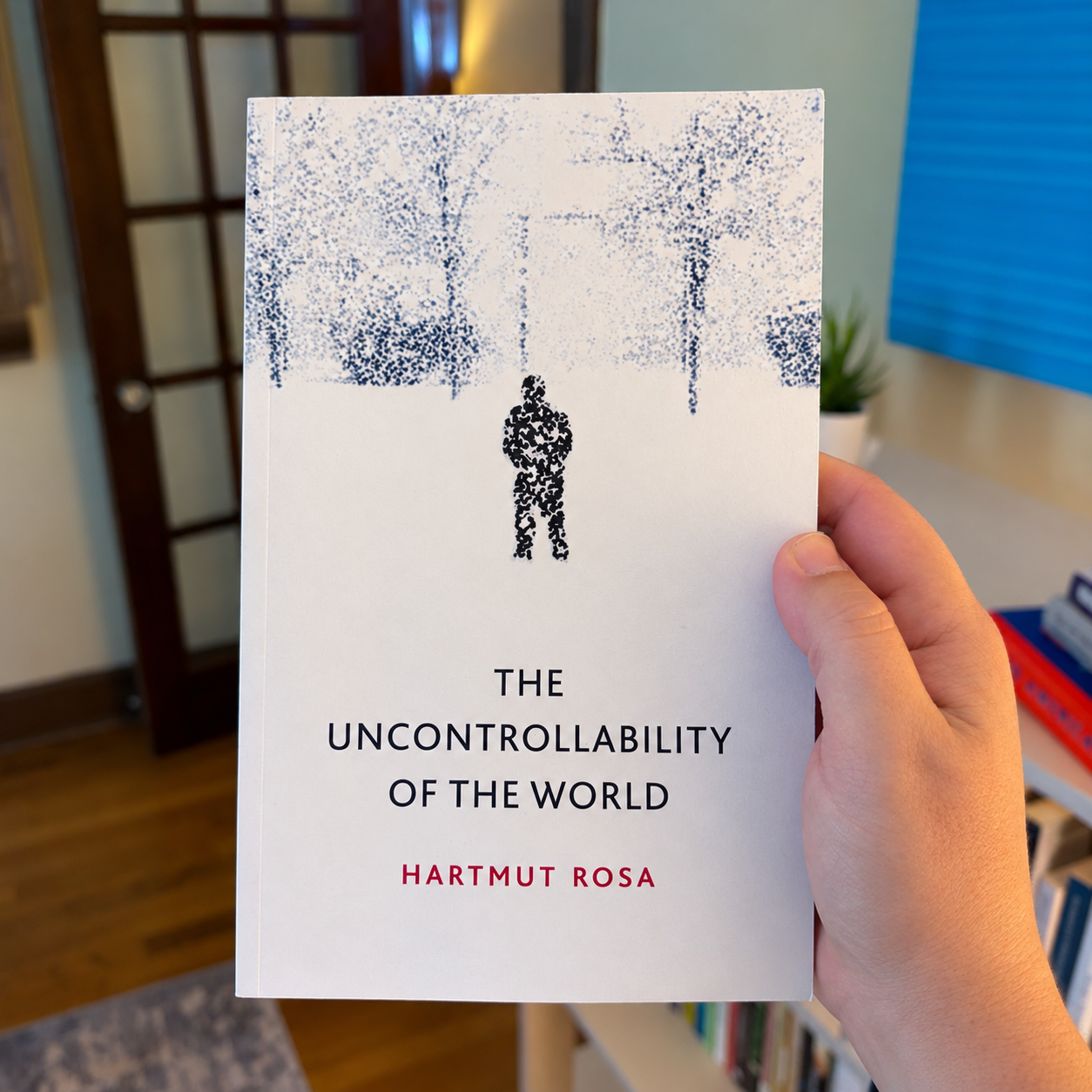
In the early pages of Uncontrollability, Rosa argues that the “driving cultural force” of twenty-first century life is “the idea, the hope and desire, that we can make the world controllable.” With everything changing so rapidly, it can be difficult to get our bearings. And when we’re disoriented, it’s natural to be frightened. The drive to bring the world—or at least our world—under control, then, makes an instinctive kind of sense.
“Yet it is only in encountering the uncontrollable that we really experience the world,” Rosa writes. “Only then do we feel touched, moved, alive. A world that is fully known, in which everything has been planned and mastered, would be a dead world. This is no metaphysical insight, but an everyday experience.”
It’s true. Here I discern echoes of C.S. Lewis, who makes a similar point in The Four Loves:
To love at all is to be vulnerable. Love anything and your heart will be wrung and possibly broken. If you want to make sure of keeping it intact you must give it to no one, not even an animal. Wrap it carefully round with hobbies and little luxuries; avoid all entanglements. Lock it up safe in the casket or coffin of your selfishness. But in that casket, safe, dark, motionless, airless, it will change. It will not be broken; it will become unbreakable, impenetrable, irredeemable. To love is to be vulnerable.
We know this from experience, don’t we? The instinct to protect ourselves from being hurt, but also the simultaneous need to open ourselves to the possibilities of love? It’s a tug of war playing out in every human heart.
Because of our late-modern human tendency “to make the world controllable at every level,” Rosa cautions, we can easily fall into the trap of reducing the world of our experience to “a series of points of aggression . . . a series of objects that we have to know, attain, conquer, master, or exploit.” As a result, the joys of “resonance”—which Christians would more readily call grace—prove increasingly elusive, resulting in loops of “anxiety, frustration, anger, and even despair, which then manifest themselves, among other things, in acts of impotent political aggression.”
Resonance, in Rosa’s framing, can never be manufactured or manipulated into being. Nor can it be “accumulated, saved, or instrumentally enhanced.” Rather, he describes it as a “mode of being” with four distinct characteristics. We might summarize them this way:
The ability to be “reached, touched, or moved” by another person, or even by “a landscape, a melody, or an idea.” We are capable of being affected from beyond ourselves. Not infrequently, these experiences will involve tears.
We actively respond. When affected, we can affect people and things around us in response. Infants experience this the first time they make eye contact with another human being; both people are affected by the encounter.
These encounters can transform us and our relationship to the world. Such transformation “makes us feel alive.” As long as we’re stuck in modes of aggression—or numbed out to avoid the pain—such “aliveness” will stay out of reach.
When we go on a first date, or wake early to glimpse a mountain sunrise, we cannot guarantee a profoundly resonant experience—and, even in fortuitous scenarios, we can’t foresee or predict how resonance will change us. In a meaningful sense, the best parts of life remain “uncontrollable.”

Just downstream from the headwaters of the Frio River on a rainy afternoon in March.
An interesting thing happened in the weeks and months after reading The Uncontrollability of the World: Rosa started turning up everywhere I looked. There he was, quoted in books as seemingly disparate as a biblical scholar’s memoir about the onset of blindness, to books on climate catastrophe and the refugee crisis. He was being name-dropped, too, by speakers and singer-songwriters at Laity Lodge. He was popping up in otherwise cheery mealtime conversations. Clearly, Rosa’s ideas have struck a chord with a growing number of us. Which, I suspect, says something significant about how it feels to alive, precisely here and now.
In a forthcoming essay for Comment magazine, I write about the “stewardship of pain,” applying Frederick Buechner’s seminal ideas and courageous witness to our present historical moment, and extending them to consider the wounds we hold not merely individually but in common. Hartmut Rosa makes one appearance late in the essay, but I was thinking of control and resonance throughout the writing, where I make a case for what I’ve come to think of as “the grace of the open hand.” (But more on that later.)
Here’s the thing: A drive for controllability leaves us with clenched fists in a world of shadows. But remaining open to resonance? That looks and feels a lot like Eucharist: the communion of saints, hands open and outstretched, the hopeful and grateful recipients of good gifts.