In Praise of Tears
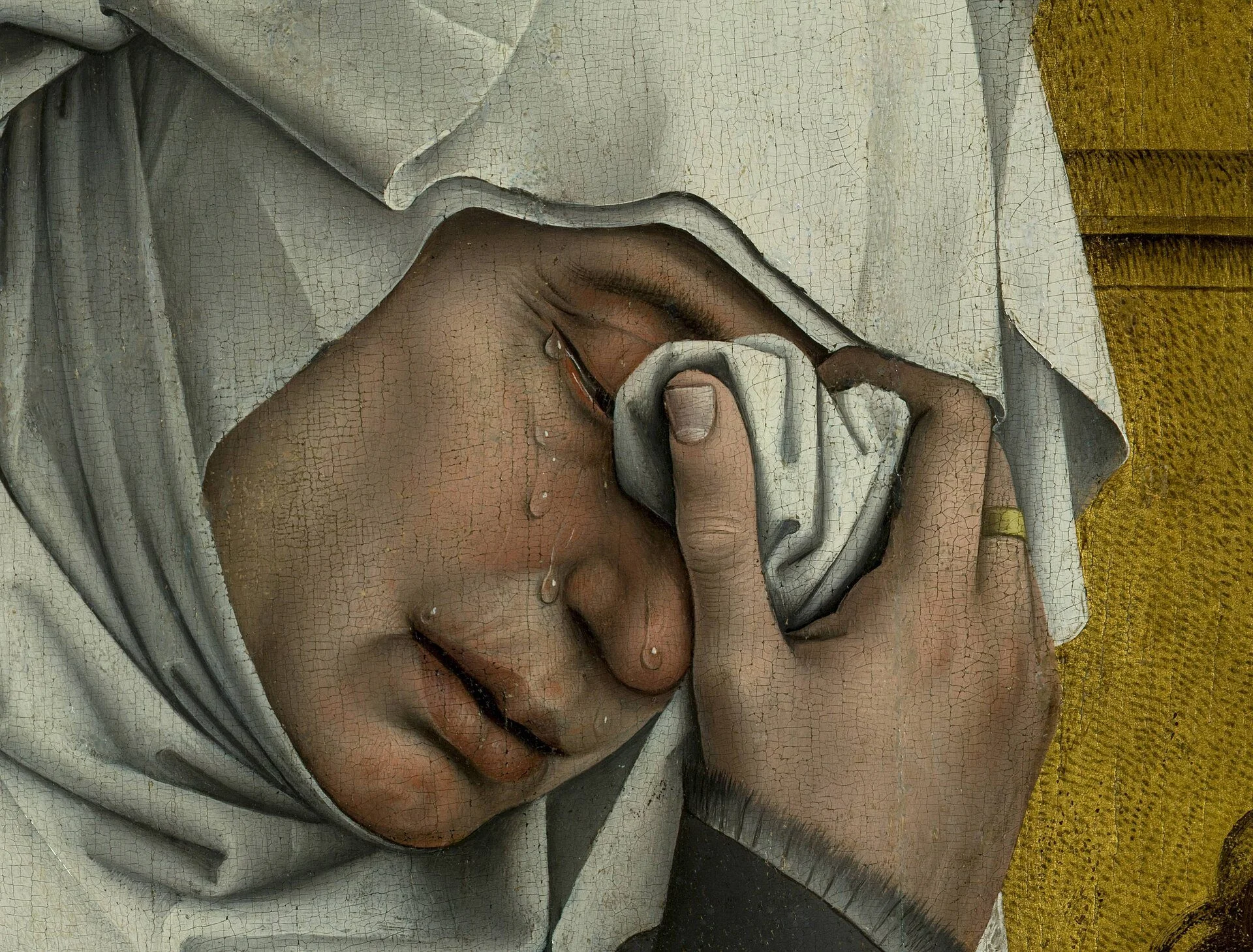
Rogier van der Weyden, Descent from the Cross (detail), c. 1435
Ten years ago this spring, Facebook rolled out a feature called “Reactions.” Gone were the days of merely deciding whether a post warranted a “like.” Now you could choose from five additional emotional responses: “love,” “haha,” “wow,” “sad,” and “angry.”
Faced with the challenge of reducing the infinite vastness of human experience to a small set of immediately recognizable emoji, the Facebook team brought in a social psychologist who previously consulted on the Pixar film Inside Out. The consultant told them they’d need a couple dozen emoji, at least. But some combination of focus groups and engineers eventually overruled her, deciding six would do the job.
The year of our Lord twenty-sixteen was an interesting time to be inviting people to broadcast not just their likes but also their loves, their amazements, their sadnesses, their outrages. A lot was going on at the time—and entirely too much of it, if you’ll recall, was happening on Facebook. By 2020, the amplitude and intensity of basically everything was “unprecedented,” prompting our concerned friends at Facebook to add yet another emoji, this one symbolizing “care.”
Truth be told, I don’t spend much time on Facebook these days. But I pop on now and then to see what’s happening in the lives of people I love—and with whom I’ve merely crossed paths, but for whom I sincerely wish good things. I rarely comment, though. Which is to say that over the years I’ve probably used each of these seven emoji on the posts of friends and acquaintances. Being emoji, these “reactions” are all laughably inhuman and criminally reductive, no doubt about it. But even emoji can be means of connection and care. They can be. I know I’ve received them as such.
+++
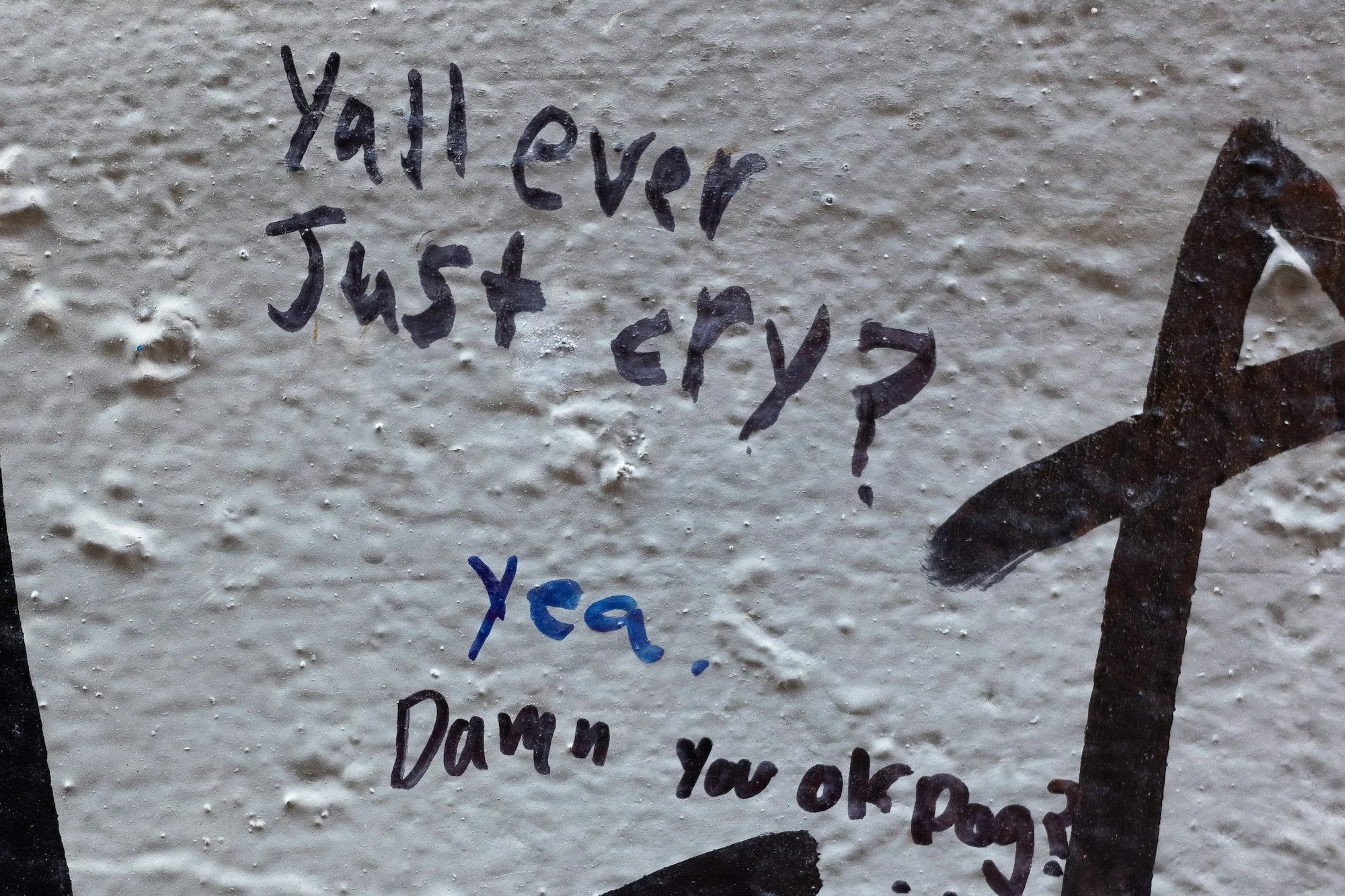
At the same time, here’s something I’ve noticed, especially when “the world” (whatever the algorithm thinks that means) is on fire, literally or figuratively: a good number of us seem much quicker to hit the “angry” button than the “sad” one. To be fair, in the face of murder, injustice, abuse, life-threatening negligence, egotism, willful naïveté, and cruelty—to say nothing of the wanton bearing of false witness against neighbors near and far—anger is a legitimate emotion. It’s absolutely valid. Just read the Psalms.
Sadness, though, is appropriate too. Sadness as well as empathy, compassion, worry, heartbreak, confusion . . . the list could go on and on, and it does. Again, just read the Psalms. We might also, with Rowan Williams, consider the life of Jesus: “Sorrow, fear, compassion, love, delight are the very stuff of moral and spiritual life. Did not Christ experience them all fully and really? Those who fancy they have put emotion behind them”—and here he turns to Augustine—“‘have lost the fullness of their humanity rather than attaining real peace.’”
Our emotions, it should be said, are interconnected in obvious and in less perceptible ways. Identifying them—much less disentangling them—is no easy task. No son enchiladas, as my friends in Sonora have taught me to say.
C.S. Lewis, in his first year of widowerhood (and initially under a pseudonym), confessed, “No one ever told me that grief felt so like fear. I am not afraid, but the sensation is like being afraid. The same fluttering in the stomach, the same restlessness, the yawning. I keep on swallowing.” Similarly, reflecting on the sudden death of her father during the awful (and now barely contemplated) pandemic of 2020, here’s Chimamanda Ngozi Adichie: “Grief is a cruel kind of education. You learn how ungentle mourning can be, how full of anger. You learn how glib condolences can feel. You learn how much grief is about language, the failure of language and the grasping for language. Why are my sides so sore and achy? It’s from crying, I’m told. I did not know that we cry with our muscles.”
Adichie and Lewis both name the surprising physicality of grief: the yawning and swallowing, the achy obliques. But anger and hope, stress and excitement, gratitude and calm—these emotions show up in our bodies too. As well they should: we are fearfully and wonderfully made.
My body remembers the moment someone wronged me, and how, in the course of metabolizing the experience—anger was the immediate and dominant emotion—I threw out my back. I wasn’t aware of injuring it in any obvious way. But anger is heavy. It took weeks for the burden to lift, to be able to drive a car or pick up the dog without wincing.
But also, in better moments—a first crush, the sight of a rare bird—who of us hasn’t felt the overflowing pleasure of joy? We need to tell someone. We need to do something. We need to move or we’ll burst.
I fondly recall the dinner last October, at an Indian restaurant in Belfast, of all places, with Katie and a crew of generous friends, when I received the offer to come work for Laity Lodge. Few things are less poetic than an email from Docusign, buzzing on an iPhone, during dinner. But the joy I felt, and the joy my friends expressed when I told them? My body won’t soon forget it. Gratitude has taken up residence within me too.
+++

Fra Angelico, The Conversion of St. Augustine, c. 1435
I’ve written elsewhere about my own prolonged experience of numbness: unable to cry, unable to feel joy—and of how Augustine taught me (and teaches me still) that our tears, or lack thereof, are worth our curious attention. The scholar Margaret Miles writes that in the Confessions, Augustine makes note of his own “tears of frustration; of physical pain; of grief over the death of a beloved friend; sentimental tears over a fictional character; tears of jealousy; grief over his mother’s death; and tears prompted by the sweetness of psalms sung in church.” At his ordination and again much later, on his deathbed, Augustine is described as weeping “copiously and continuously.” Miles rightly characterizes those end-of-life tears as “richly complex.”
Augustine did not die joyless.
Absurd as it is to ask, what would this “richly complex” Augustine have made of Facebook’s seven woefully inadequate emojis? What would he make of the fact that, ridiculously constraining as they are, we sometimes can’t figure out how to access the emotions on even this limited range? What would Augustine make of our tendency, online and IRL, to steer clear of tears?
I’m reminded of an essay by my friend and mentor Winn Collier, in which he writes, “Tears are essential. Tears provide a compass for the soul.” He continues:
I’m worried for us because it seems we are getting better at rage and cynicism, as well as despair and apathy. But we’re becoming increasingly disconnected from our tears. Too often, tears are mocked or shamed, supposed signs of weakness or manipulation (tears are not manipulative — manipulative tears are manipulative). When we sense the stirring, we often blush, apologize, or turn away. But we need these tender disruptions if we’re going to remember who we are and what our future might be.
One of tears’ great gifts is how they connect us to each other, to our shared humanness — and this is what I fear we’re losing. Maybe we should place a moratorium on correcting or debating each other until we’ve first connected with the tears over another’s pain. Can you imagine what would transform in our common life if, before whatever disagreements, we first truly heard the tender hopes we hold for ourselves or for our children? Or pondered the deep beauties that move us? Or shared the common aches that keep us awake in the night?
Yes, friends, tears are gifts. Let’s receive them—and give them away.