Meanwhile

Among the perks of being a writer who reads widely is the joy of discovery, the experience of being surprised, of having one’s world expanded and possibly deepened. One drawback is that it’s sometimes hard to keep track of just where you picked up what.
I’m not talking about plagiarism. I’m talking about those small tics¹ you notice in the writers you admire, the subtle tendencies which breed delight—the words and phrases and paragraphs that stop you in your tracks, make you go, “Dang. I want to hold onto that. I’d like to try that sometime.”
For instance—and I have no idea why—I absolutely love it when writers end sentences with –ing words. Here’s one from This is Happiness, where novelist Niall Williams doubles them up just for fun: “By that time, my grandparents’ house would be another of those tumbledown triangles of mossy memory you see everywhere in the western countryside, the life that was in them once all but escaping imagining.”²
Or when a familiar noun like “essay” is turned into a less common verb like “essayed.” Or, even more, when a singular noun is made plural, but in a truly unexpected way. An example of this latter magic trick comes from Mary Karr’s Lit, her extraordinary memoir of “getting drunk and getting sober.” I’ll situate it in context (emphasis added):
At the end of my drinking, the kingdom I longed for, slaved for, and at the end of each day lunged at was a rickety slab of unreal estate about four foot square—a back stair landing off my colonial outside Cambridge, Mass. I’d sit hunched against the door guzzling whiskey and smoking Marlboros while wires from a tinny walkman piped blues into my head. Though hours there were frequently spent howling inwardly about the melting ice floe of my marriage, this spate of hours was the highlight of my day.
I was empress of that small kingdom and ruled itin all weathers. Sleet, subzero winds, razor-slicing rain. I’d just slide a gloved hand over my tumbler, back hunched against the door. I defended my time there like a bull with a lowered head, for that was the only space in the world I had control of.³
Mary Karr could have done the totally sensible thing, opting for “in all kinds of weather.” But then she wouldn’t have been Mary Karr, would she?
+++
A year ago, this very month, my essay “The Sacred Art of Paying Attention to Your Life” was published. The first major piece of writing for my doctoral program, this essay marks a shift into a new mode of writing for me: more personal, more explicitly theological, possibly more invitational. There are parts of it I struggled to write. But other parts came quickly, like the opening:
I met Augustine in Cambodia.
Earlier that summer, two modern masterpieces—There Will Be Blood and No Country For Old Men—were shot in desolate stretches of West Texas. During the World Cup final, Zinedine Zidane head-butted Marco Materazzi in the chest. Two days later, terrorists set off a series of bombs on passenger trains in Mumbai, killing 209 people. Shakira kept insisting hips don’t lie. Pluto got demoted.
Meanwhile, I was in the middle of a wandering, wondering decade. Those first ten years of adulthood were spent searching for meaning, for belonging, for a faith capable of sustaining me through all the questions I was finding urgent and inescapable.
In Augustine, I found a friend.
I wrote those lines in October 2024. And despite all the many edits to the essay that were to come, these lines remained almost entirely unchanged, all the way through to publication.
Pretty quickly, though, I called to mind Lucy S. R. Austen’s fascinating biography of the enigmatic Elisabeth Elliot, which I’d read earlier in the year. I recalled the way Austen begins some of her chapters with a litany of events happening in the world, before zooming in on what was happening in the life of Elliot at the time. Here’s an example:
On June 3, 1963, “It’s My Party (And I’ll Cry If I Want To)” hit number one on the pop charts, and Governor George Wallace promised to fight desegregation at the University of Alabama. On the third, Pope John XXIII died. On the seventh, the Rolling Stones appeared on TV for the first time. On the ninth, Congress passed the Equal Pay Act. On the sixteenth, cosmonaut Valentina Tereshkova became the first woman in space; the next day, the US Supreme Court ruled that state-mandated Bible reading and recitation of the Lord’s Prayer in public schools was unconstitutional. On the twentieth, the US and the USSR signed the hotline agreement in an attempt to prevent nuclear war. A few days later, Elisabeth Elliot left Ecuador. She was thirty-six years old.⁴
Reading the biography, I was conscious of reveling in this mode of writing, this choice to situate micro stories in macro context. It didn’t feel like a distraction to me; rather, it helped me enter more deeply into Elliot’s lived reality in that particular summer of 1963.
I knew I’d seen this kind of thing done before. But I couldn’t call any specific books or authors to mind. All I knew is that I loved it and wanted more of it to exist in the world.
+++
We now find ourselves, friends, in the midst of another World Cup summer. Two European giants—Germany and the Netherlands—were knocked out early. African nations like Cabo Verde have made awe-inspiring runs. Leo Messi, meanwhile, continues to defy the laws of gravity and time.
In the spirit of the season, this weekend I decided to dust off Eduardo Galeano’s Soccer in Sun and Shadow, one of the most endearing (and enduring) books about the beautiful game I’ve ever come across. Early short chapters set the stage for the drama about to unfold, introducing us to a few of the main characters like The Idol and The Fanatic and The Referee.
Then, about 60 pages in, we get to the first-ever World Cup, in 1930, held in Galeano’s native Uruguay. And there it is: the whirlwind roundup of (mostly political) events swirling around the tournament at the time. He does it again for 1934 in Rome, and 1938 in Paris, and so on. Here’s just a taste, from Galeano’s introduction to the 1982 World Cup in Spain, held just a few months before my own birth:
García Márquez was accepting the Nobel Prize in the name of the poets, beggars, musicians, prophets, warriors, and rascals of Latin America. In a village in El Salvador, a hail of army bullets was killing more than seven hundred peasants, half of them children. In order to expand the butchery of Indians, in Guatemala General Ríos Montt was taking power by force, proclaiming that God had given him the country’s reins and announcing that the Holy Spirit would direct his secret service.⁵
In the final that summer at the Bernabéu in Madrid, Italy beat Germany 3-1. Striker Paolo Rossi won the Golden Boot, scoring six goals in the tournament. Thirty-one years later, Ríos Montt would be convicted of genocide and crimes against humanity, though the verdict was later thrown out on a technicality. Ríos Montt died on Easter Sunday in 2018, awaiting his retrial.
Paolo Rossi and Ríos Montt have nothing to do with each other. Paolo Rossi and Ríos Montt have everything to do with each other.
+++
Consider, in closing, this Venn diagram.
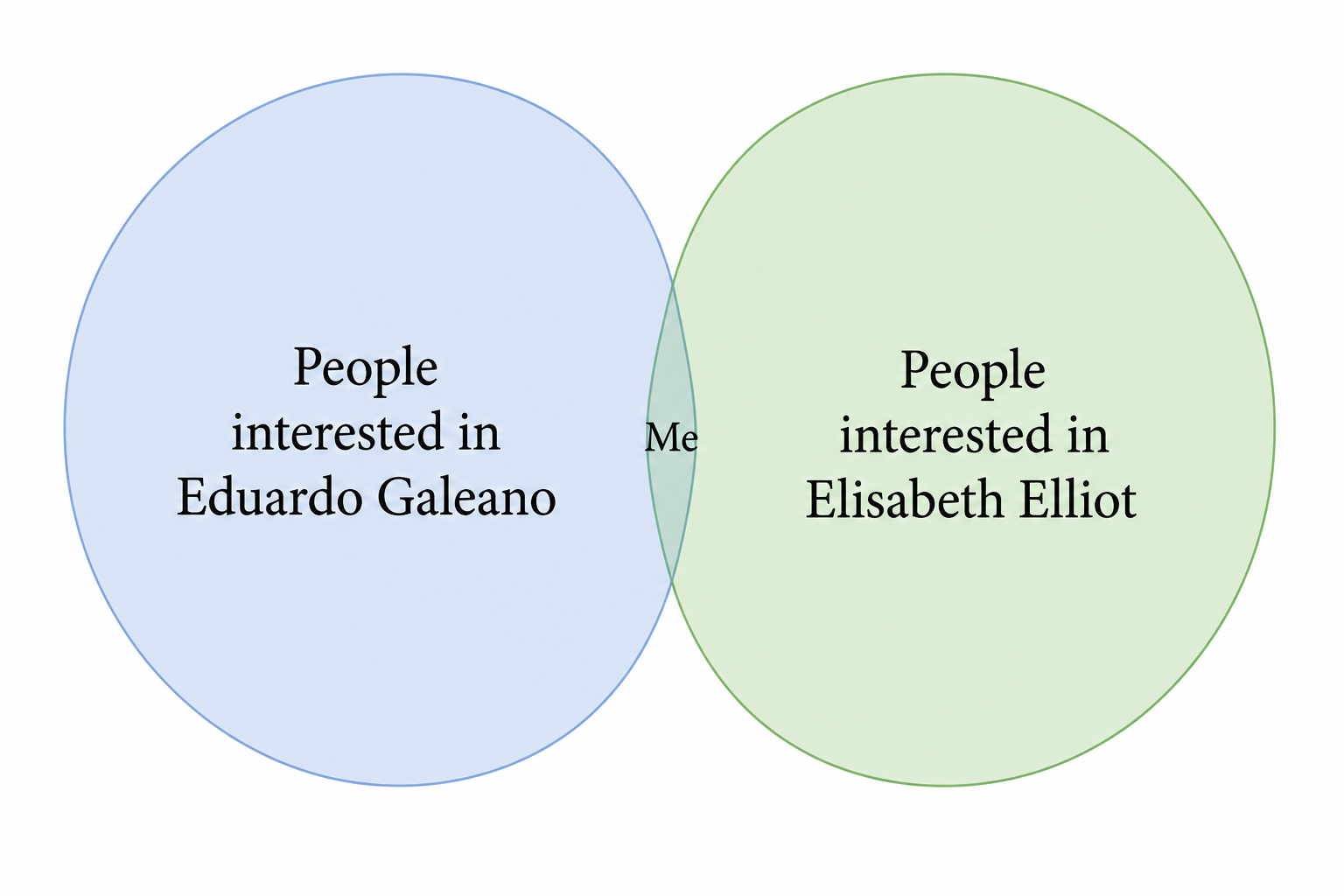
I’m not sure it’s a badge of honor exactly, but there simply can’t be very many people in the world eager to read (and reread) Eduardo Galeano who would also choose to spend time with a hefty biography of Elisabeth Elliot. But here I sit, I can do no other.⁶
And this does something to explain why I write the way I do. It does something to explain why what feels like a semi-conscious flow state is in fact just one result of decades of reading and rereading stuff that interests or enlivens me—stuff that in all likelihood would not interest you, at least not in quite the same way. I write the way I do because I read the way I do, because I notice what I do, because I delight in (or am allergic to) the literary choices others have made and continue to make.
My Venn diagram isn’t your Venn diagram. Nor is my Venn diagram the same as Eduardo Galeano’s, or those of Elisabeth Elliot or Mary Karr or Niall Williams. Thank God for all the Venn diagrams of the world. Thank God for alchemy.
NOTES
¹ Tics? Meticulously crafted practices? Sometimes it’s hard to say.
² Niall Williams, This is Happiness, p. 368
³ Mary Karr, Lit, p. 7
⁴ Lucy S.R. Austen, Elisabeth Elliot: A Life, p. 377
⁵ Eduardo Galeano, Soccer in Sun and Shadow, p. 182. It’s fascinating to me that I instinctively set the opening of my essay during the World Cup summer of 2006—including the note about Zidane’s temper—but until now hadn’t connected the dots back to Galeano.
⁶ Dear Martin Luther: I’m so sorry.