1.
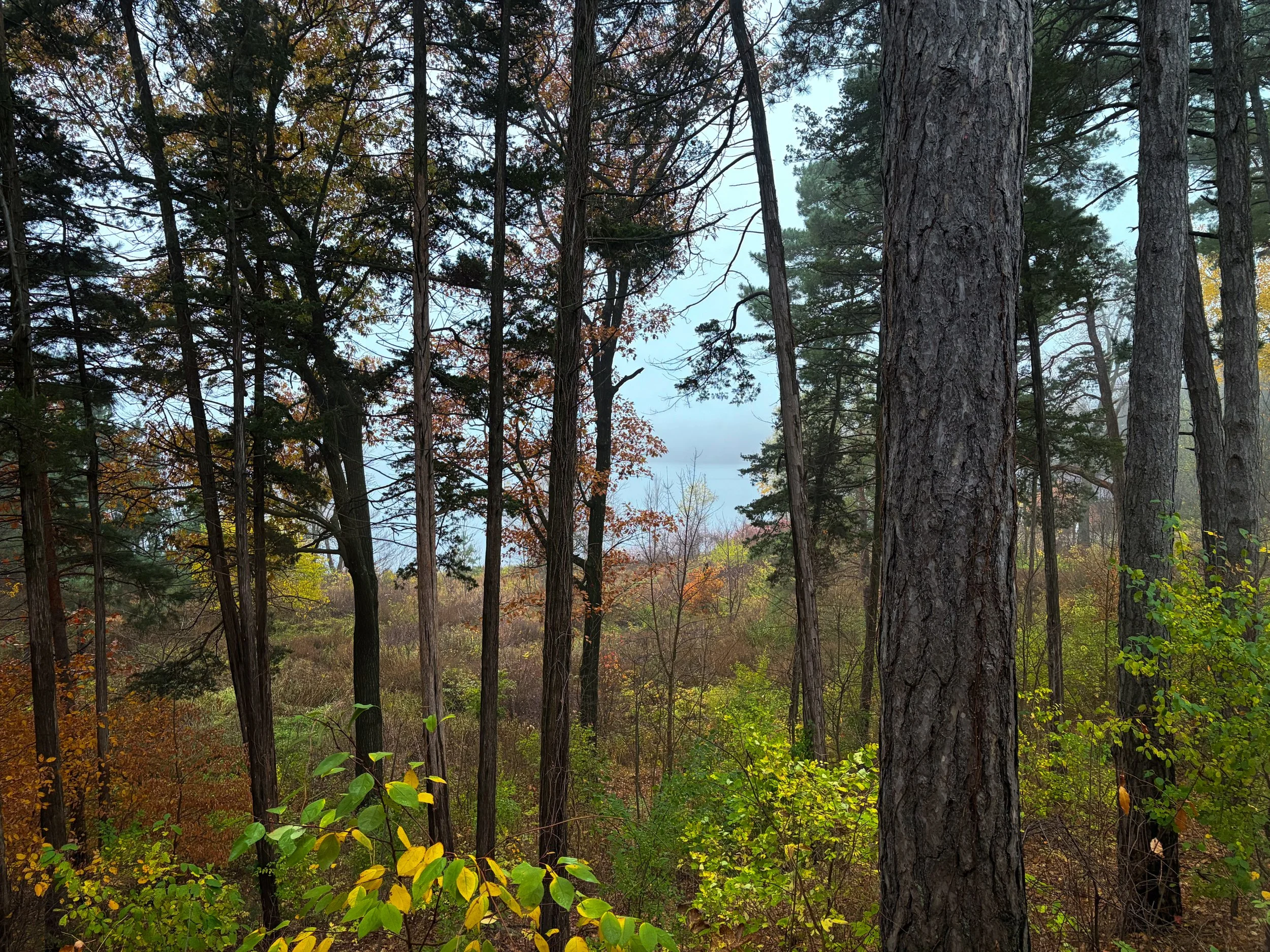
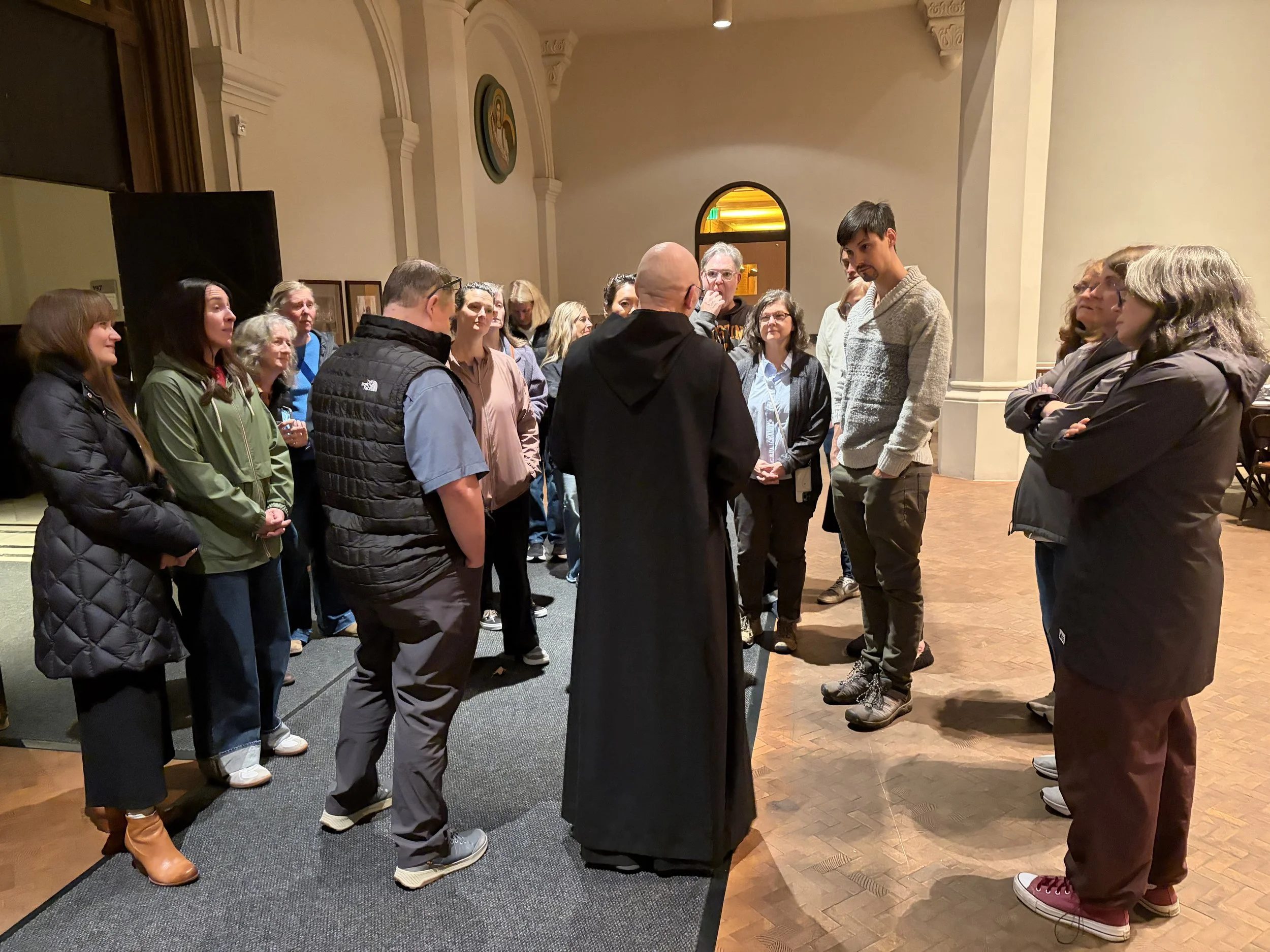
We arrive at the guesthouse in a gray mist. Winter is coming. Blessedly, the trees hold on for us—red maples, yellow aspens, burnt orange oaks, all cheerfully refusing to let go. A monk named Cyril welcomes us. He looks just like Thomas Merton, only Benedictine: bald, thin, black habit with a hood. Having laid down some monastic guidelines, he gives us the keys to our rooms.
2.
“In the rule of St. Benedict, the offices of guest-master and cellarer are, after the rank of abbot and prior, those that call for the solidest faith and character, since they bring holder into daily and hourly contact with the influences and distractions of the outside world.”
—Patrick Leigh Former, A Time to Keep Silence
3.
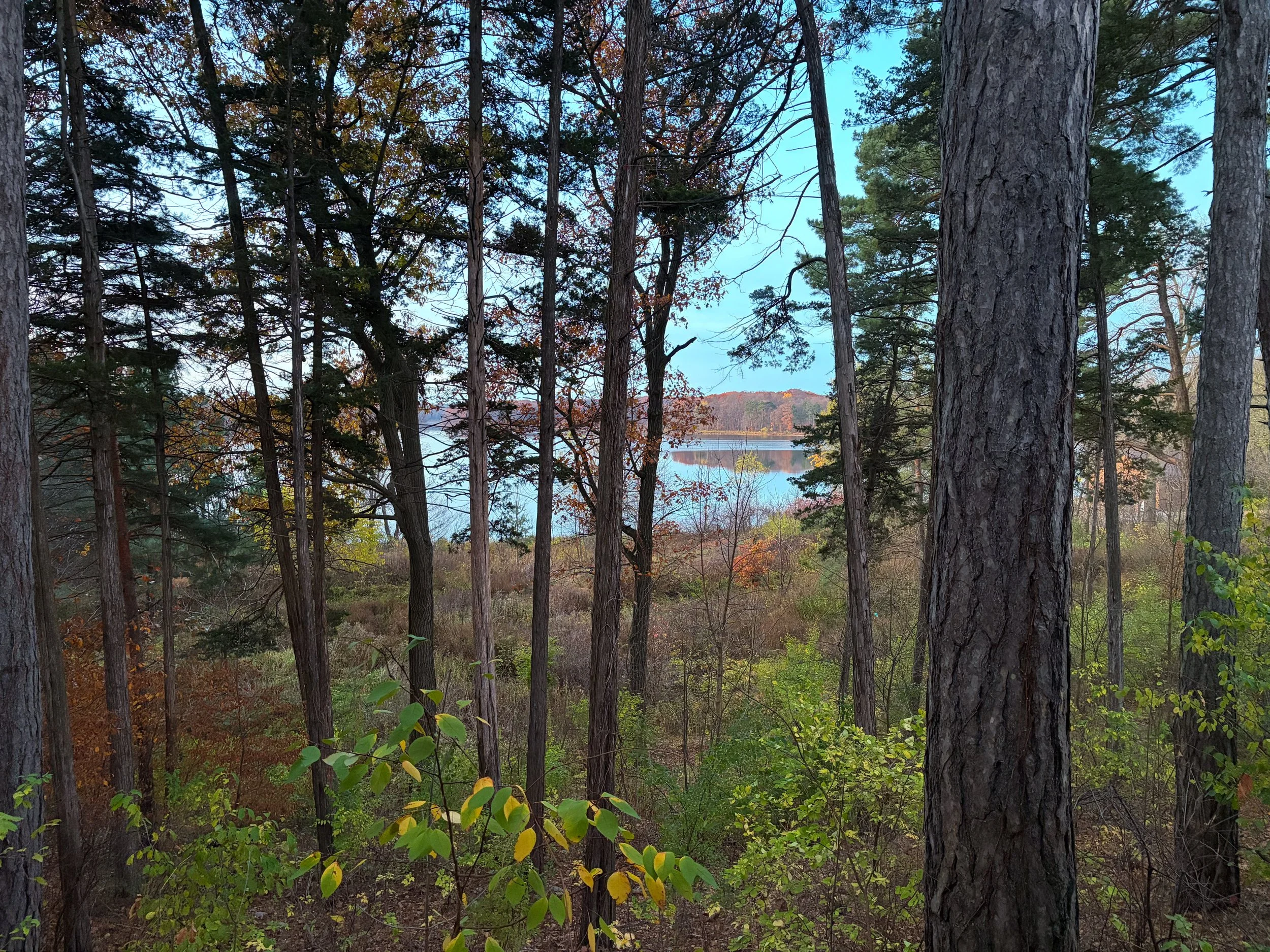
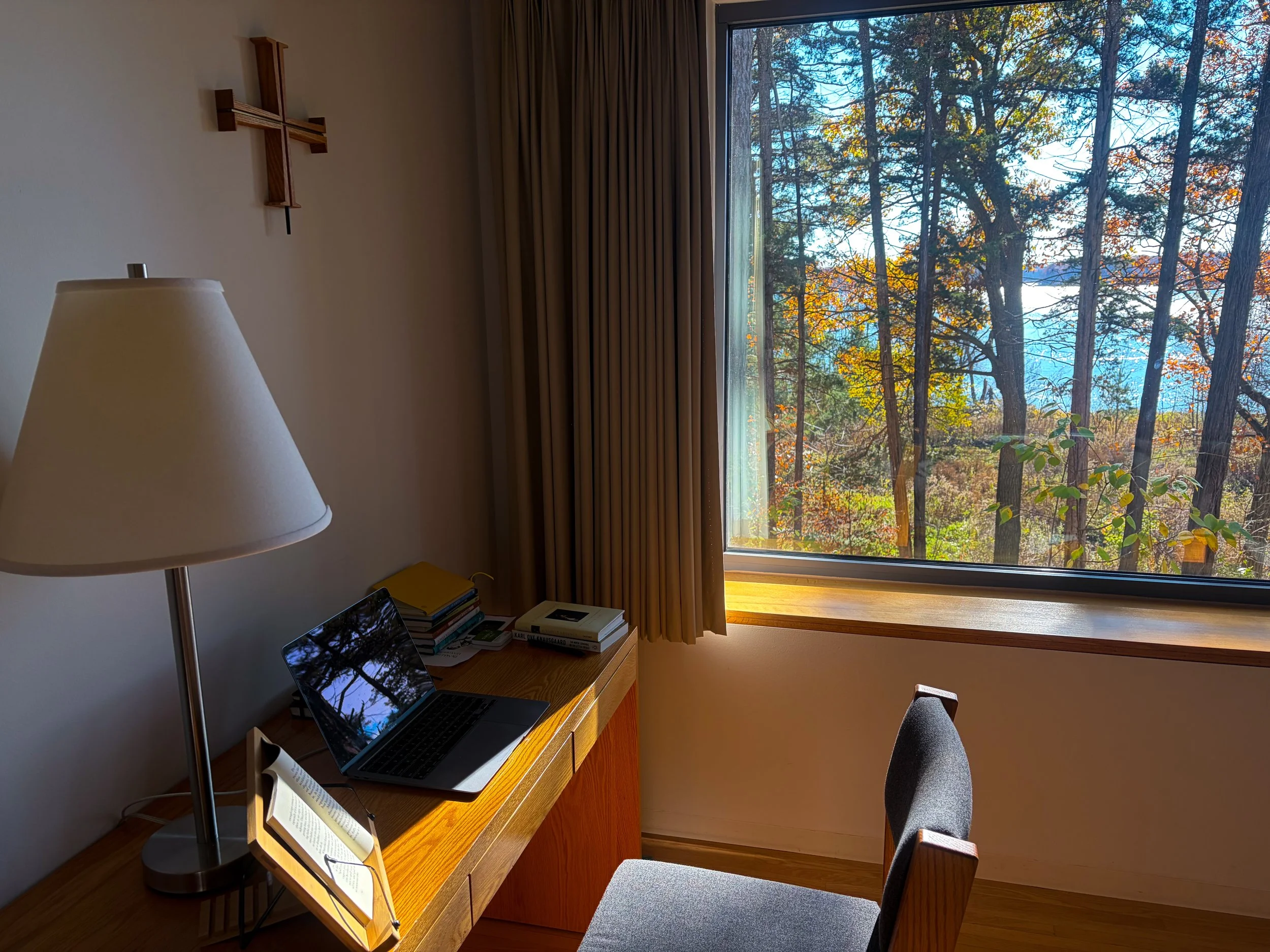
I’m downstairs in 004, three doors down, presumably, from Mr. Bond. It’s a simple room with a twin bed, a reading chair, and a writing desk. Beside the bed is a battered Bible and a copy of the Rule. And then, out there, a panoramic view of Lake Sagatagan through the trees. With 24 pals and three mentors, I’ve come here for a weeklong writing retreat. It’s our last time together before next April, when—the Lord being our helper—we’re slated to graduate.
4.
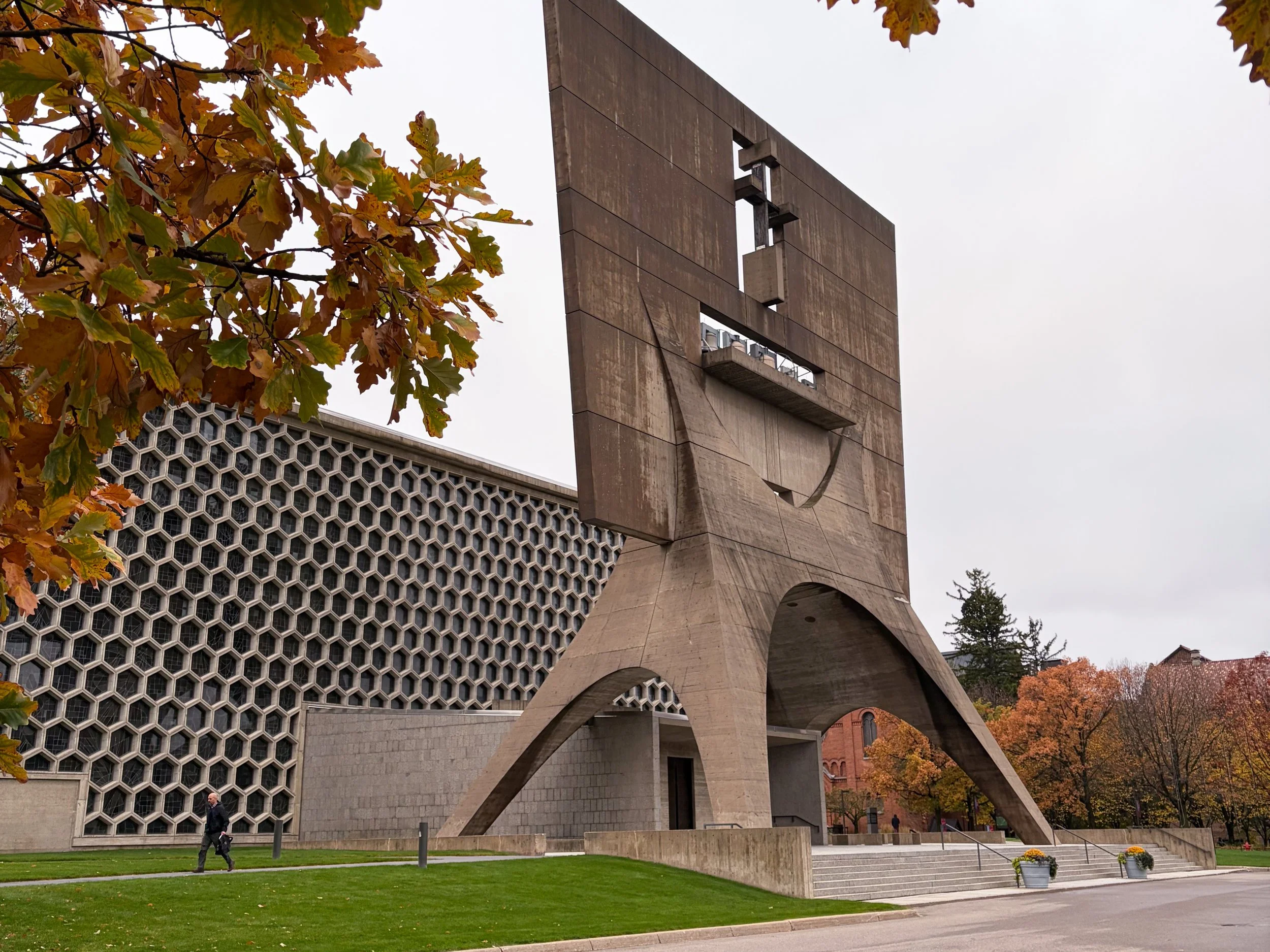
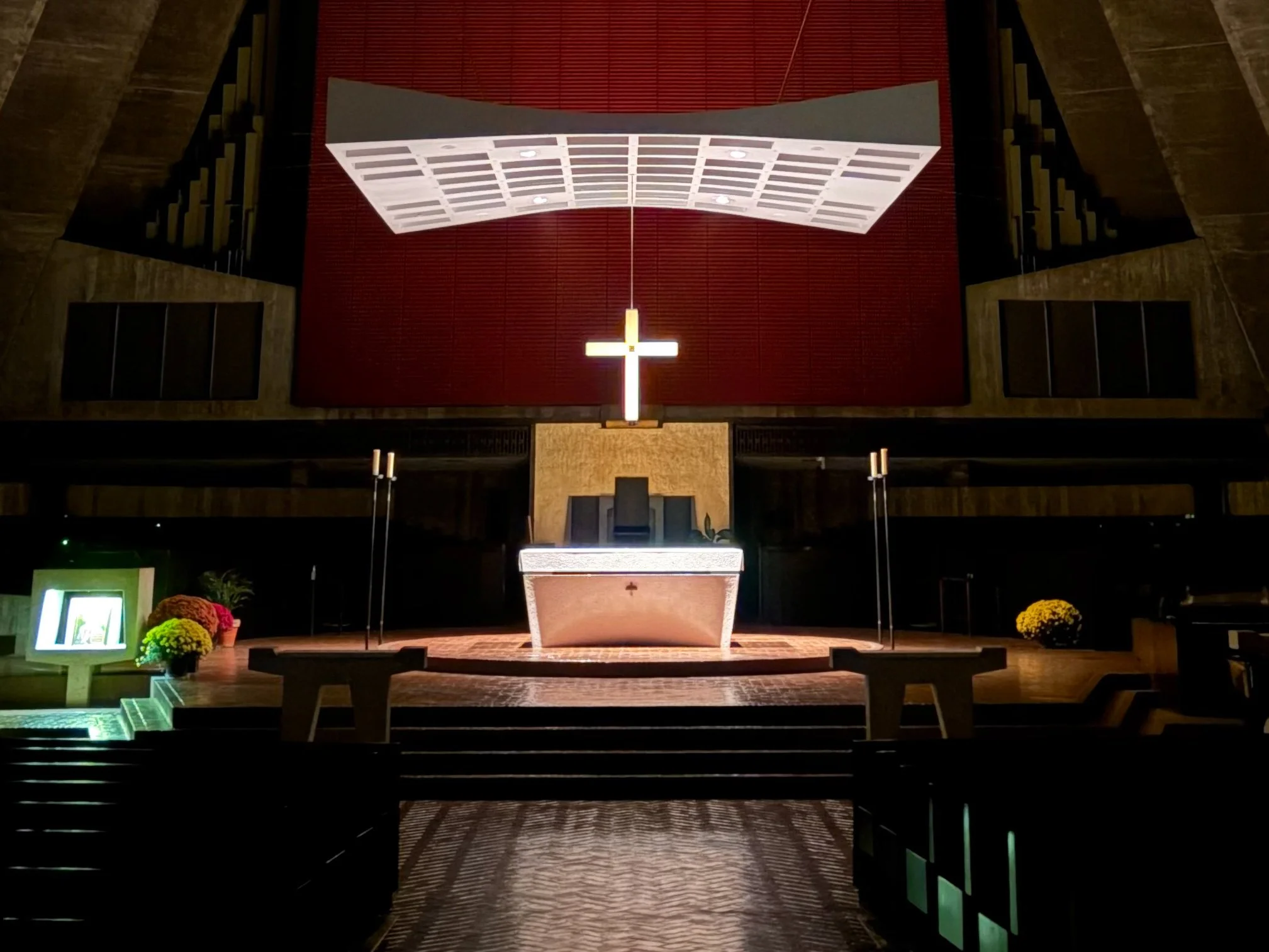
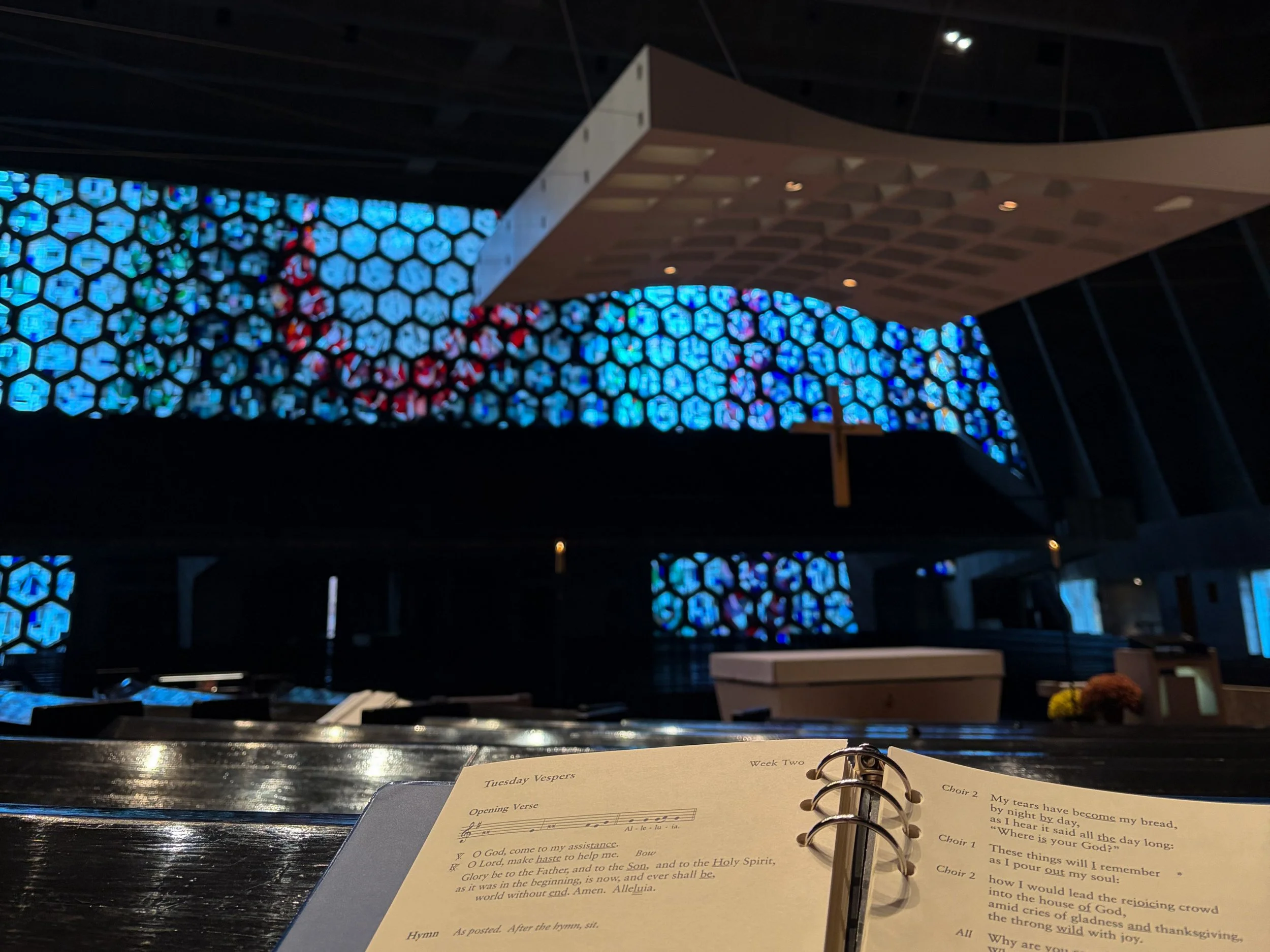
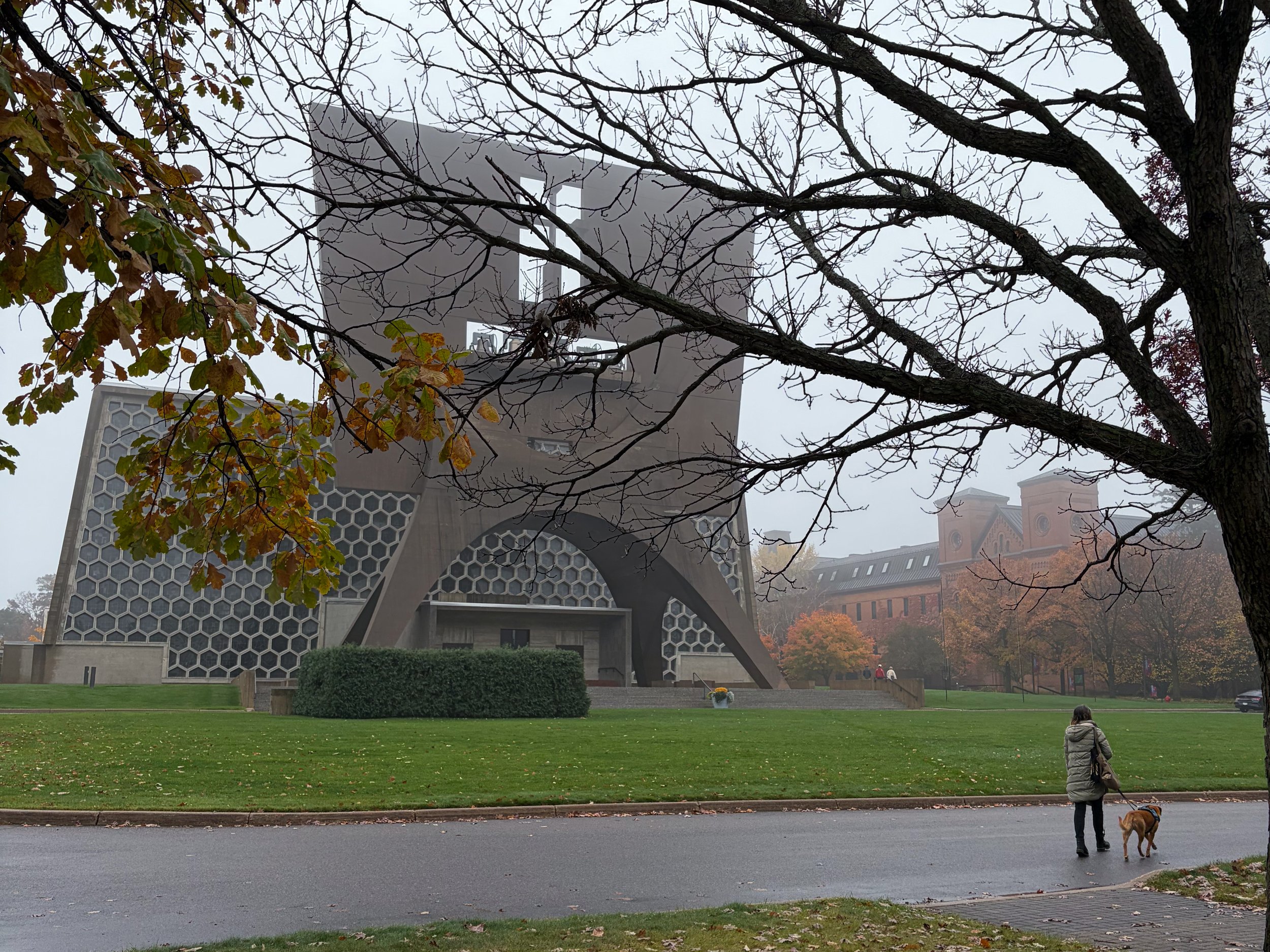
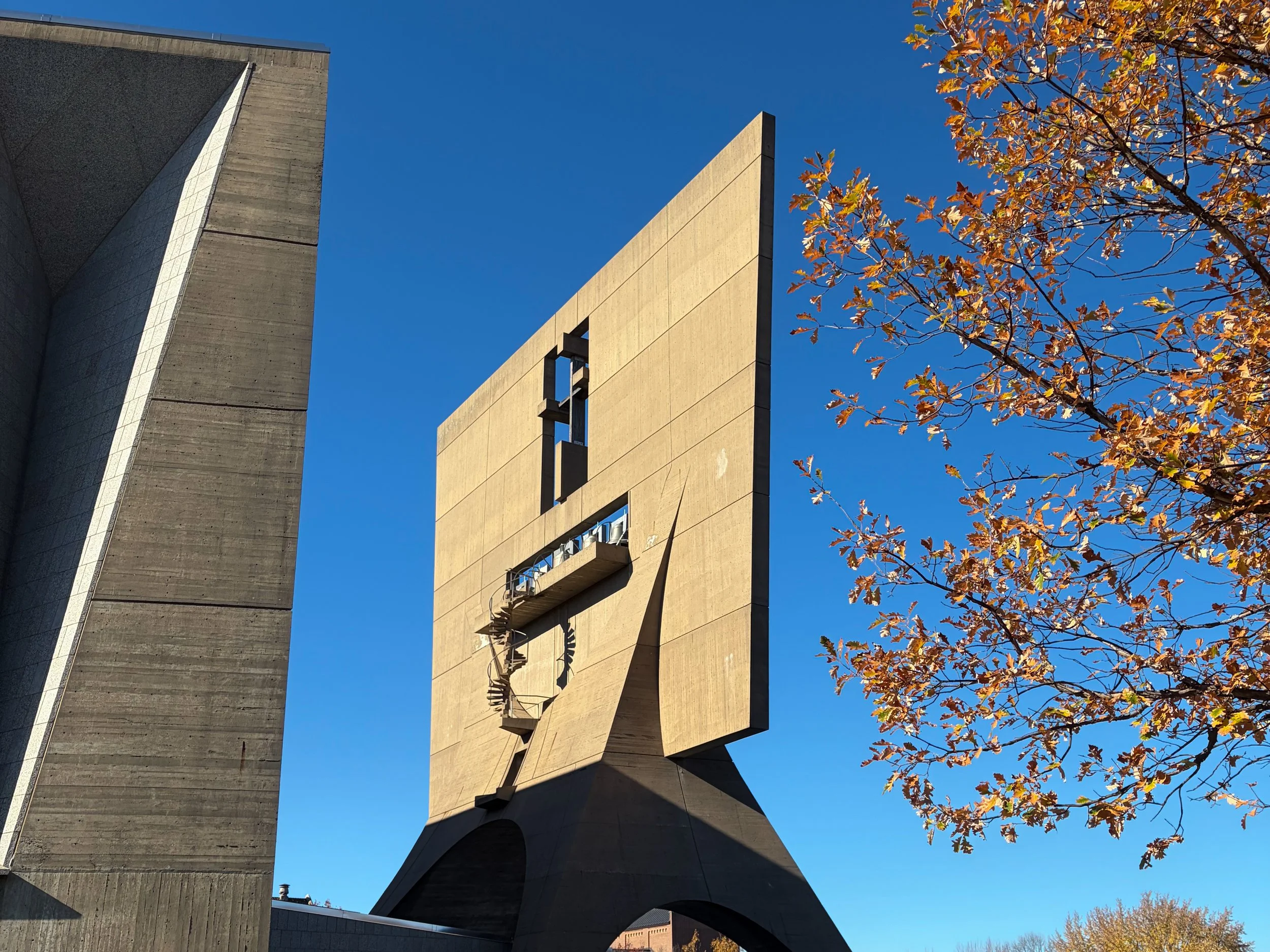
Next to the guesthouse is the Abbey Church, a hulking brutalist masterpiece built with enough concrete to pave a small city but designed to give everyone here—monks, students, parishioners, visitors—a surprising sense of intimacy. This has been achieved, the website says, “by building a vast worship space without columns based on a trapezoidal shape that would enable everyone to sit as close as possible to the altar.”
5.
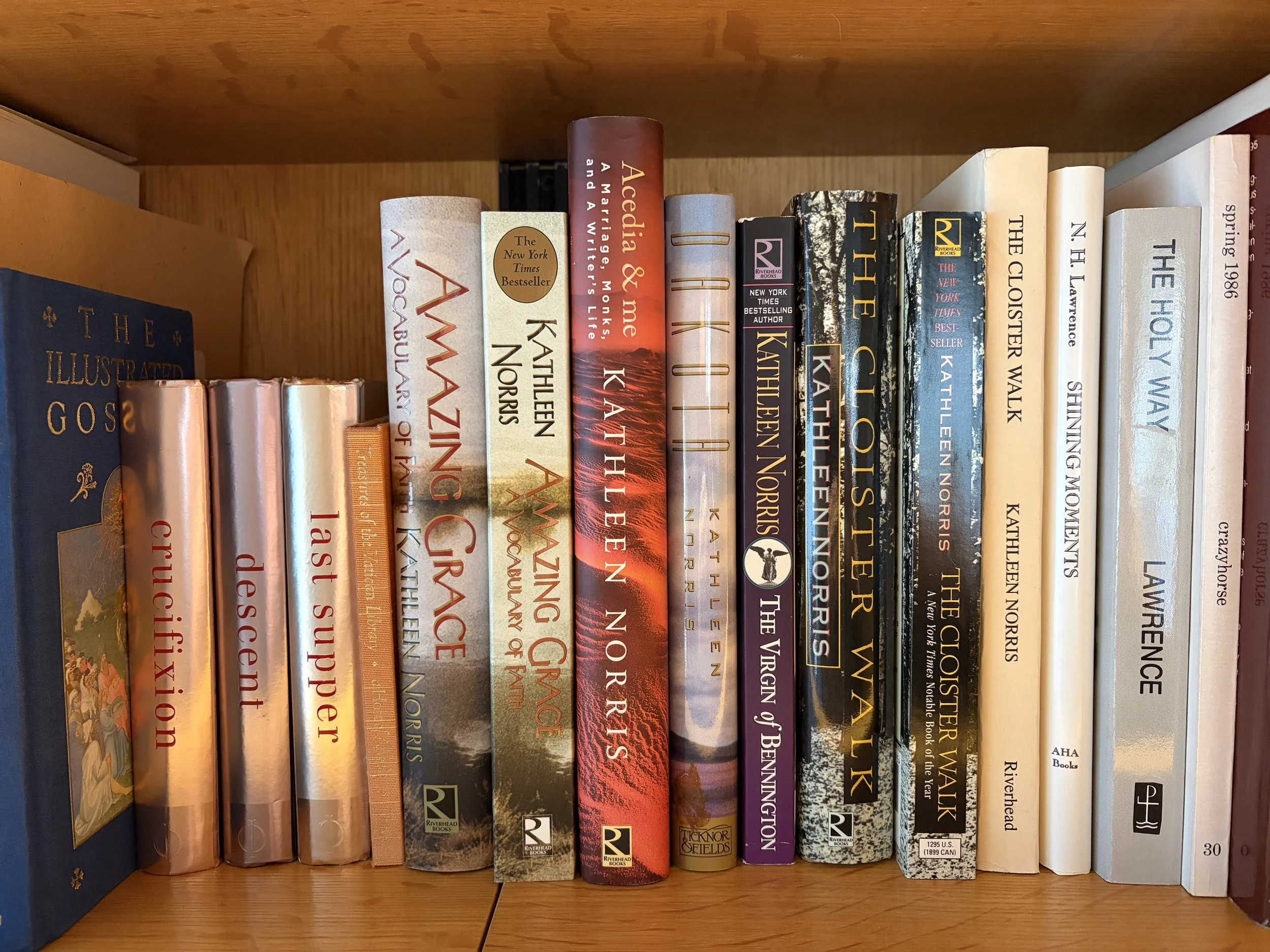
During a recent Zoom call with our band of writers, Kathleen Norris told us about her time as an oblate at this abbey, visits which form the basis of her book The Cloister Walk. “Daily prayer is the anchor of time there,” she said, encouraging us to go to as many prayer services as possible during our stay. “Get to morning prayer early,” she continued. “See who the morning-people monks are. See who staggers in just in time.”
6.
More than an hour before sunrise, we file into the church’s choir, taking our seats in a semicircle around the altar. This is Lauds, the first prayer service of the day. Cyril urges us to join in the prayers, going so far as to help us find the right page in the right prayer book as well as the hymn chosen for this day. He also asks us to restrain ourselves; first-time participants have a tendency to participate with a little too much gusto, he says. There’s no need to shout.
The spot next to me in the back row has a placard indicating it’s reserved for the head abbot, a septuagenarian with the sniffles. He arrives just after us, but still with a few minutes to spare. Obviously not his first rodeo. Other monks glide silently in as the service begins. Then, after a while, a young monk appears, taking his place a few rows below us and to the left. In the dim light he bears an uncanny resemblance to a particular tech overlord. A penitent version of him, perhaps. Br. Sam (as I’ll call him) rubs his eyes. He yawns. It may be my imagination, but I think the head abbot takes note. The younger monk says his prayers.
7.
“Prayer should therefore be short and pure, unless perhaps it is prolonged under the inspiration of divine grace. In community, however, prayer should always be brief; and when the superior gives the signal, all should rise together.” (Rule of Saint Benedict 19.4–5)
8.
When I sit at my desk to work, the room is quiet, almost hauntingly so. The only sound is my fingers on the keys. That, and the tick, tick, ticking. I take off my Swatch watch—a recent gift—and put it in the bathroom. I go back to my typing.
9.
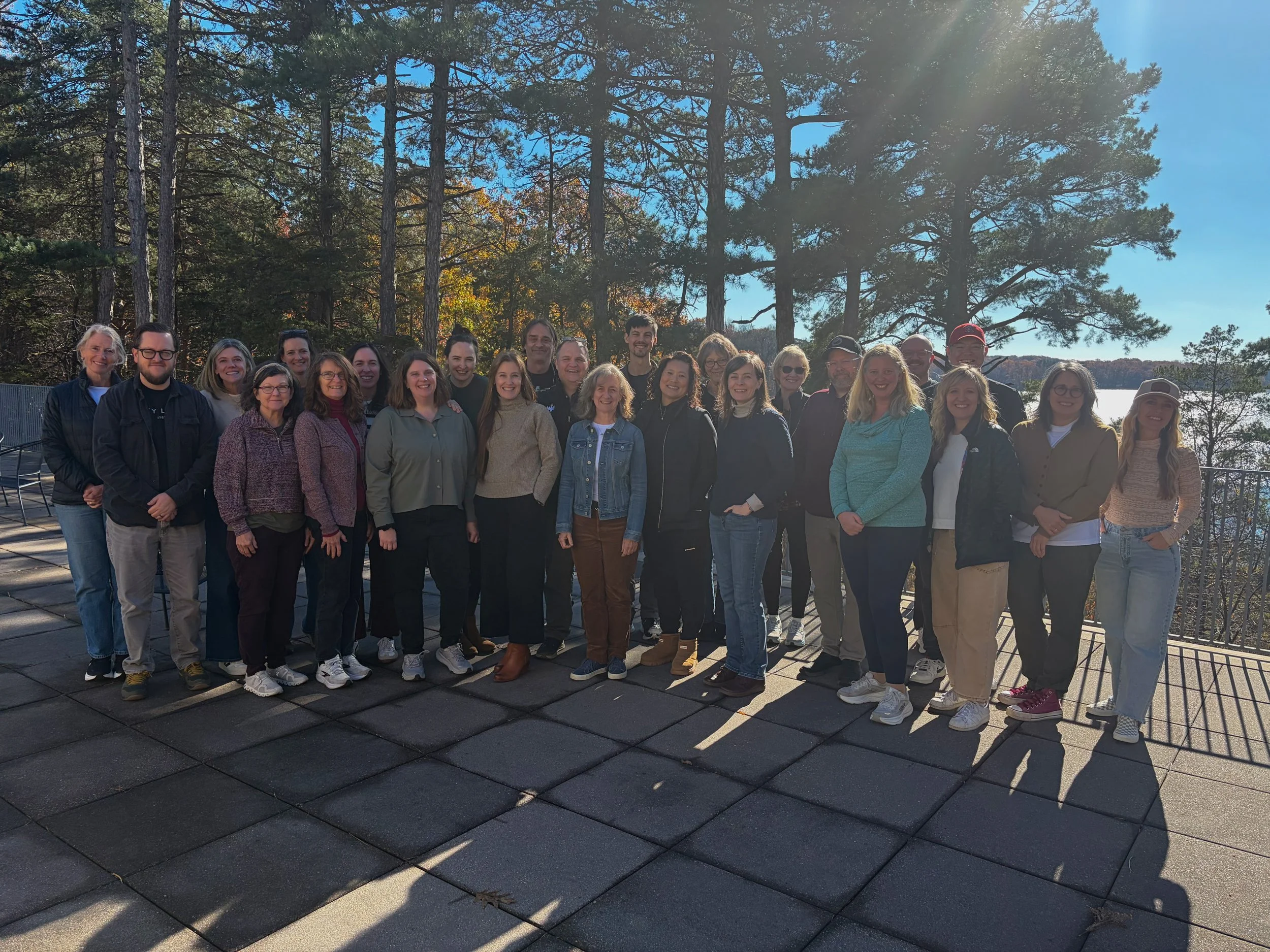
Our group of writers first gathered two years ago, which feels impossible—I’m still pinching myself I get to be in their ranks—yet here we are, coming down the home stretch. Each in our own way and all of us together, this week we’re dotting our Is, crossing our Ts, eradicating superfluous uses of the word “that.” (God help me, I count 22 instances of the dreaded word here . . . though three of them come in a single sentence from Wallace Stegner, vanity compels me to note.)
I’m nowhere near ready for this cohort to disband.
10.
In a group session focused on Nathaniel Hawthorne and The Scarlet Letter, one of our mentors invites us to pay attention to shapes in the book, including the shapes of letters themselves. The H in Hester Prynne and the A in Arthur Dimmesdale, she points out, are nearly identical, simply formed at different angles. Same with the R in Roger Chillingworth and the P in Pearl, with the one small stroke setting them apart.
Add steeples and scaffolds to the mix, as well as prison walls and the “triangle” of the central family, and what we find is “a very geometric book”—set against the backdrop of the wild contours of the natural world. For Hawthorne, she says, “symbols are multivalent.”
11.
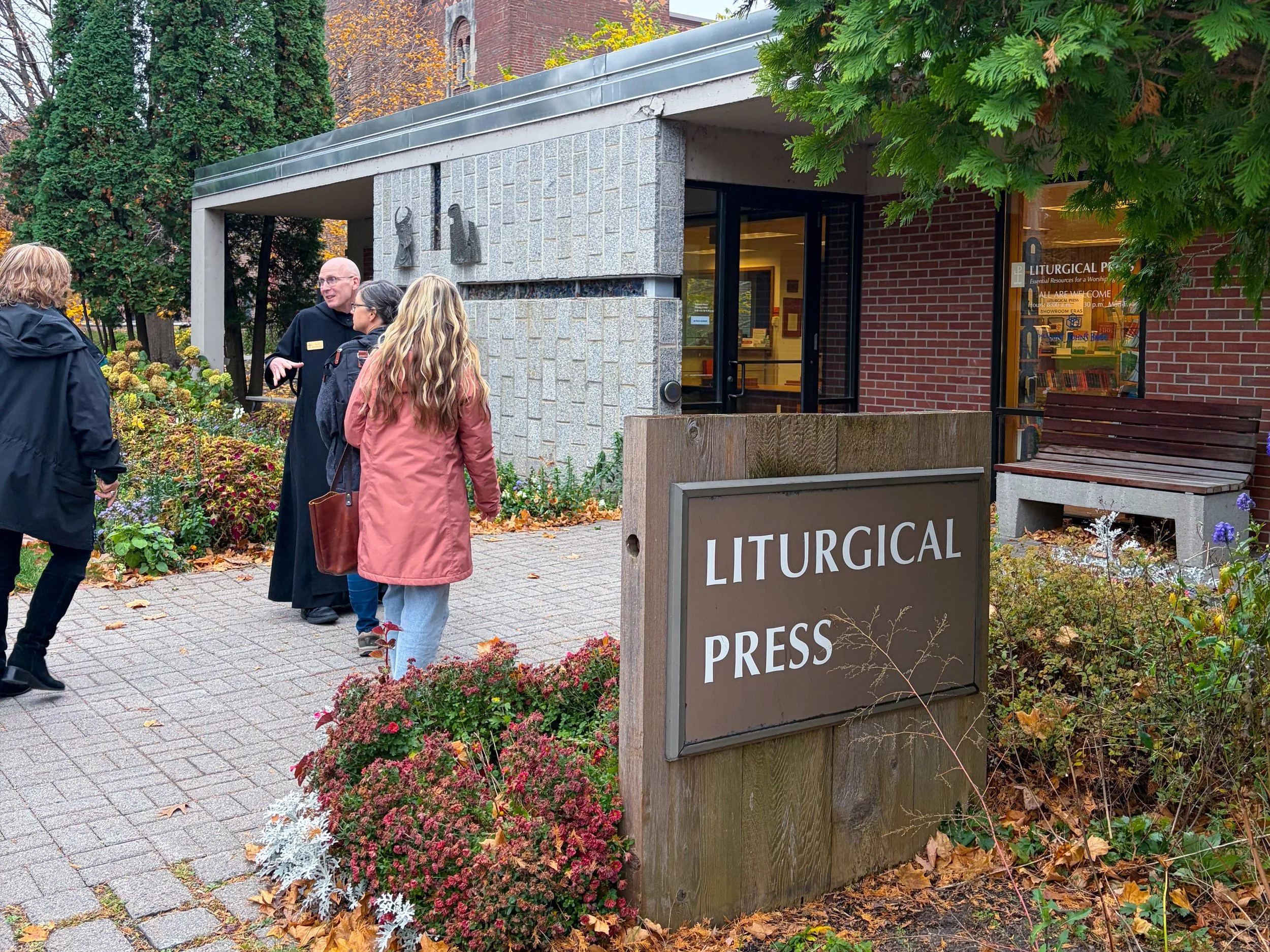
On a guided walk to the Liturgical Press bookstore, I tell Cyril he reminds me of Thomas Merton, or at least of the likeness I know from a few black and white pictures. “I think I may just have a generic monk look,” he says, touching the top of his head. I don’t press the issue. A few steps later he smiles and says, in little more than a whisper, “But yes, I sometimes see the resemblance.”
12.
I sleep poorly Monday night and decide, somewhere in the wee hours, it will be best, just this once, to skip Lauds. I reach for my phone and set my alarm back an hour, to 7:15.
I am jolted awake by a blaring menace assaulting my eardrums. It takes a moment to figure out this is no emergency alert on my phone but is in fact the alarm clock on the nightstand, which I haven’t so much as touched . . . and which did not go off the first morning. The clock reads 6:00. I fiddle with it in the dark but it keeps on screaming. I get the lamp on, find the switch, and see it is somehow already set to OFF. A second later, the screeching stops.
The rest of the week, I don’t touch it. Neither does it make a peep.
13.
“The life of monks passes in a state of white-hot conviction and striving to which there is never a holiday . . . They have foresworn the pleasures and rewards of a world whose values they consider meaningless; and they alone have as a body confronted the terrifying problem of eternity, abandoning everything to help their fellow-men and themselves to meet it.”
—Patrick Leigh Fermor, A Time to Keep Silence
14.
A friend who is part of our group tells me she looks at the Abbey Church from the outside and everything about it offends her. It feels self-evidently inhuman. But then she goes inside and feels something else entirely. How can a big concrete bunker feel so alive, so welcoming?
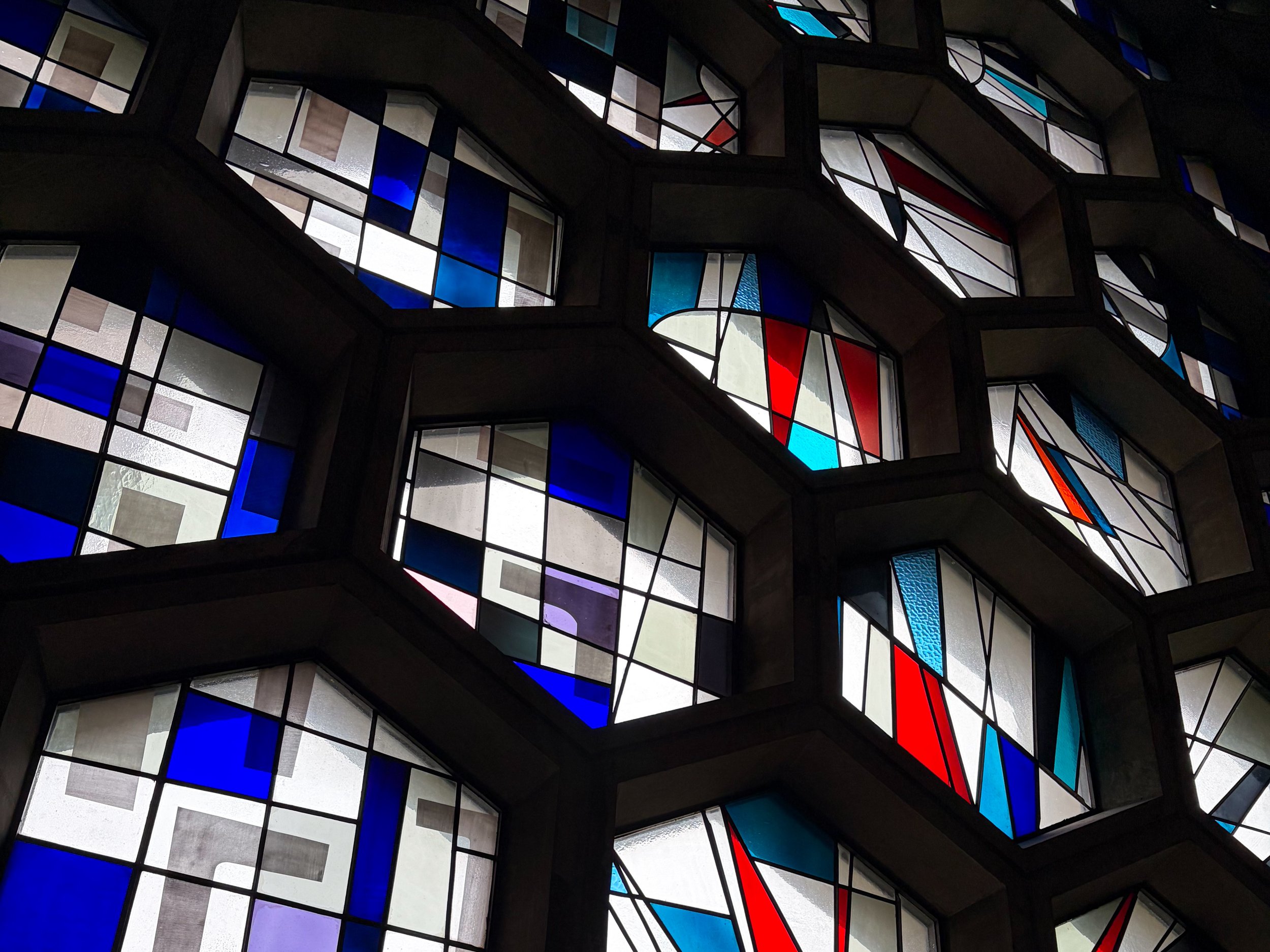
The church was designed by Marcel Breuer, a Bauhaus-trained architect born in Austria-Hungary in 1902, one of the real-life inspirations for the critically acclaimed film The Brutalist. Breuer was chosen for the job, the abbot at the time later said, in part because he was modest, truthful, a good listener.
Arnt Cobbers, an art historian who has specialized in church architecture, sets the scene this way: “The interior, which is free of internal supports and offers seating for 1,700 people in the nave, on the freestanding gallery and on the horseshoe-shaped benches of the choir, is illuminated by low windows and an amber-coloured skylight over the altar and through the northern wall. The latter has windows embedded in a concrete structure made up of 540 hexagons.”
The completed church—along with many other buildings at St. John’s Abbey and the connected university—are among Breuer’s crowning achievements.
15.
“Sometimes it is impossible to say why and how a work of art achieves its effect,” writes Karl Ove Knausgaard in So Much Longing in So Little Space, a book about his brooding countryman, the Norwegian painter Edvard Munch. “I can stand in front of a painting and become filled with emotions and thoughts, evidently transmitted by the painting, and yet it is impossible to trace those emotions and thoughts back to it and say, for example, that the sorrow came from the colours, or that the longing came from the brushstrokes . . .”
16.
With my fellow writers, I have been working on my project for the past two years. We want to write artfully and honestly, generously and generatively. “Loving language,” Marilyn McEntyre writes, “means cherishing it for its beauty, precision, power to enhance understanding, power to name, power to heal. And it means using words as instruments of love.” This week my focus is on revisions: writing and rewriting scenes, adding texture throughout, reworking sentences and paragraphs I like but which, it turns out, only make sense to me.
17.
One afternoon I take a long nap. I am not normally a napper.
18.
“Liturgical time is essentially poetic time, oriented toward process rather than productivity, willing to wait attentively in stillness rather than always pushing to ‘get the job done.’”
—Kathleen Norris, The Cloister Walk
19.
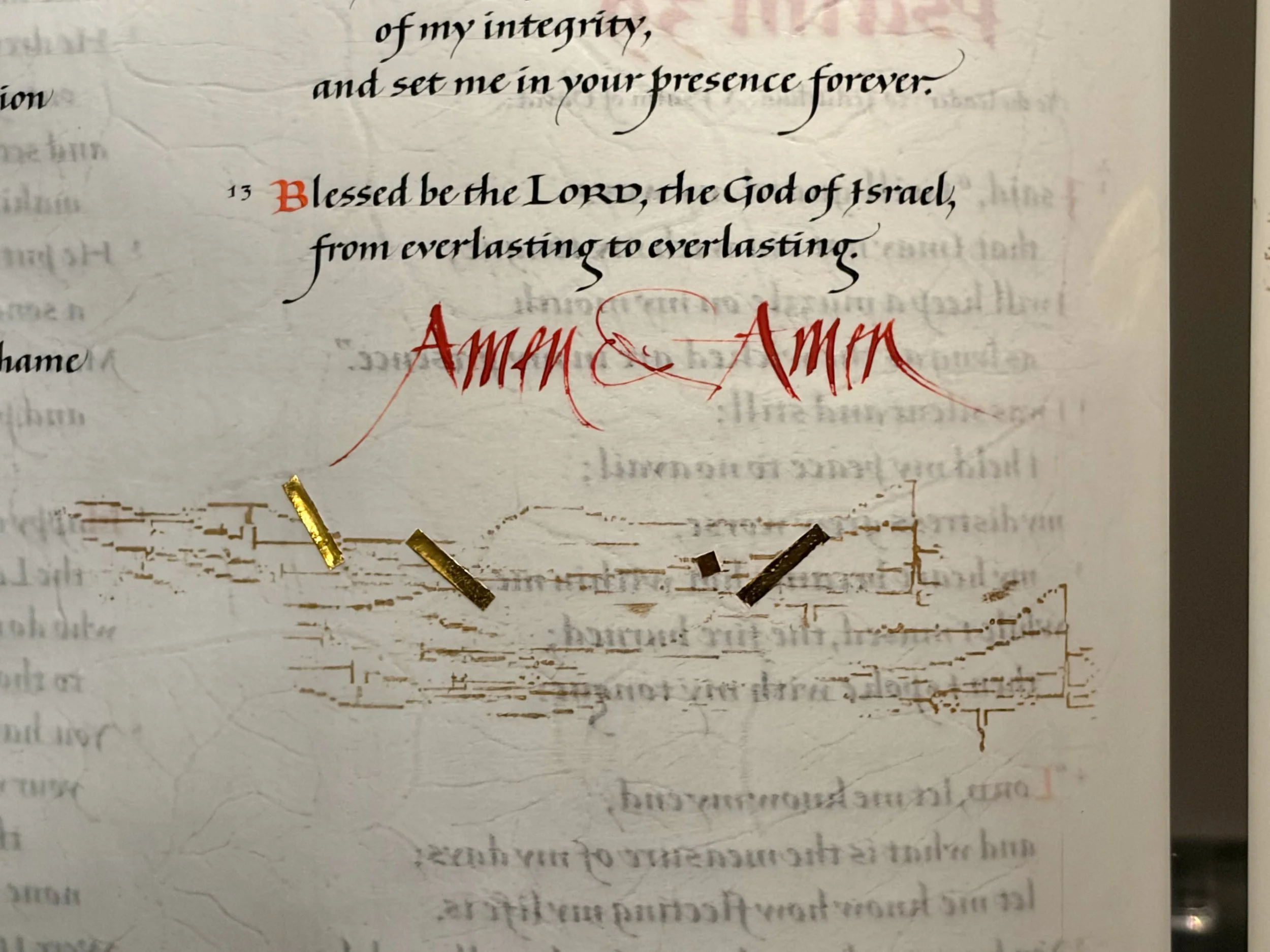
In the weeks leading up to our visit, I am told that the wood-fired ceramic workshop is going to be one of the highlights of our week. Then we learn it’s temporarily closed. We are, however, invited to visit an exhibition featuring the Saint John’s Bible, painstakingly illuminated by hand on calf vellum. The makers of this Bible used an oscilloscope to convert audio recordings of the monks chanting the psalms into visible soundwave patterns, stamped in gold on every page of the Psalter.
20.
“If there are artisans in the monastery, they are to practice their craft with all humility, but only with the abbot’s permission.” (RB 57.1)
21.
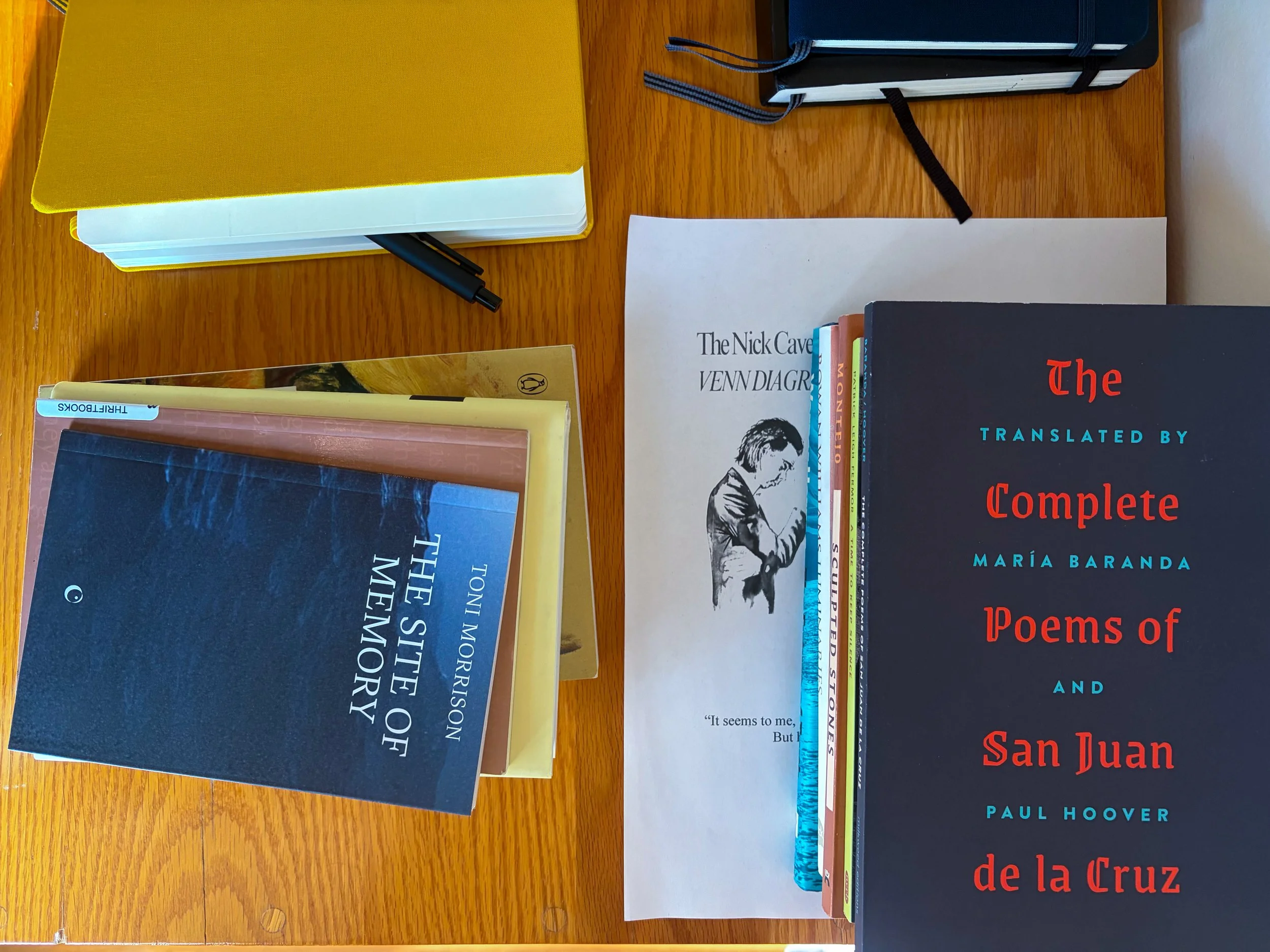
I’m reading Toni Morrison in my room when the thought occurs to me: the Mississippi River’s headwaters are in Minnesota. I open the Maps app. When we arrived on Sunday, we left the airport and drove northwest along I-94. Basically the whole time, we were running parallel to the Mississippi River. I had no idea.
22.
“You know, they straightened out the Mississippi River in places, to make room for houses and livable acreage. Occasionally the river floods these places. ‘Floods’ is the word they use, but in fact it is not flooding; it is remembering. Remembering where it used to be. All water has a perfect memory and is forever trying to get back to where it was. Writers are like that; remembering where we were, what valley we ran through, what the banks were like, the light that was there and the route back to our original place. It is emotional memory—what the nerves and the skin remember as well as how it appeared. And a rush of imagination is our ‘flooding’.”
—Toni Morrison, The Site of Memory
23.
Thursday morning. The sun appears for the first time all week.
24.
We are given a tour of the organ-making facility. We learn so much about pipes: how longer pipes produce deeper notes, how lead pipes sound better than tin ones, how tuning involves tinkering with small openings in the pipes, how pipes are eventually lifted out of the shop using a crane. Someone asks about the long-term business prospects of making organs, this being the twenty-first century and all. “We’re currently booked six years out,” the apprentice-guide tells us. “The world needs more organ-makers.”
25.
Wallage Stegner taught creative writing for many years at Stanford. During one fellowship application window, he recalls receiving two letters of application on the same day. One was verbose and highfalutin, the other succinct. “He wanted, terribly, to be ‘literary.’ She wanted to write stories.” Only one of them received the fellowship.
26.
Some evenings we gather in Room 105—the “Saint Benedict Meeting Room”—to read aloud some of what we’ve been working on for the past two years. One of us, a Pentecostal pastor, gives an especially lively reading from his novel. Two women share their poems. Others read what has emerged from their wisdom, their training, their joy, their grief. I break the rules, slightly, opting to read a few paragraphs I’m working on about checking into an abbey guesthouse in the fog and meeting a monk named Cyril.
“Merely having a story read aloud and discussed makes it, in the author’s eyes, more serious and more worthy,” Wallace Stegner says. “And that group around the table may be the best audience, though not the biggest, that that writer will have in his life.”
27.
Cyril tells us he was once called Anthony. When he became a monk, he was given the option of keeping his name or choosing a new one. There was already a monk named Anthony, so he chose the name Cyril, after a great-uncle he liked. “He was a gentle man. The only thing strange about him was that he didn’t like baseball.” A Brewers fan, Cyril is having a good week.
28.
In his book Pure Act: The Uncommon Life of Robert Lax, author Michael N. McGregor writes about Lax’s lifelong friendship—despite fundamental differences in temperament—with Thomas Merton:
“One of the main differences between Merton and Lax was that Merton was a brilliant and tireless self-promoter, while Lax was often taciturn or tongue-tied in public, relying on his work to speak for him. Another was that Merton was vitally concerned—in college and later—with finding answers, while Lax seemed much more comfortable with questions. Decades down the line, while Merton shouted to the world what he’d discovered in the cave of solitude, Lax sat quietly within, offering an occasional smoke signal.”
29.
Cyril strikes me as a smoke signal guy. I like that about him. After our final Compline, I ask if he offers spiritual direction.

30.
Augustinian priest and scholar Martin Laird writes in A Sunlit Absence that “saints and sages” from Evagrius to Diadochos to Augustine have consistently cautioned that the “undeniable luminous Vastness that slips out of any clothing that mere words can weave, but of which every tongue must tell, is not a physical light that occurs in space and time.” They remind us “that this mystery we call God is beyond what can be grasped as shape and form in the way we grasp tangible things.”
31.
At breakfast on Friday, we give hugs and exchange farewells. Then we scatter, for the time being, to the four winds.