Three Crosses
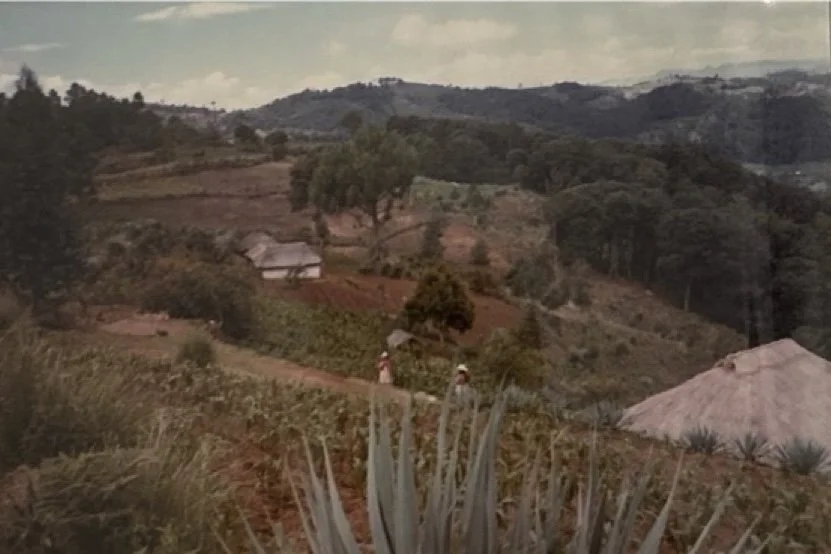
I can still picture Tres Cruces as it was back then. A tiny hamlet on a mountain ridge in the far western reaches of Guatemala—a small country on a seismically volatile isthmus, lost (it would seem) between American continents. You’d be forgiven for calling Tres Cruces the ends of the earth. You’d be forgiven for not knowing it’s there at all.
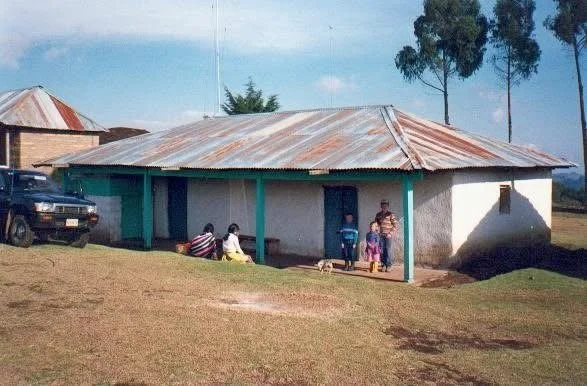
Inconsequential by all reasonable standards, this village was for years my home. Our missionary family rented a small adobe building that had served as a one-room schoolhouse. With plywood partitions for bedroom walls and a blue-tarped ceiling to keep out the rats and the rain, little by little we converted it into a house. Running water was still years off, so every few days we hiked down to a spring to fill plastic jugs. In the evenings, when the sun retreated behind the mountains across the border in Mexico, we ate rice and beans by the light of a Coleman lantern. One night a stray bolt of lightning found our ham radio antenna and blew a hole out of the adobe wall. When I close my eyes I can still hear the deafening roar of the laminated roof during those downpours.
Our neighbors—indigenous farmers barely eking out a living on tiny, impossibly steep patches of craggy farmland—wouldn’t have known what to make of us. We were gringos with navy blue passports, after all, wealthy enough to come and go in a Toyota Hilux pickup truck. And yet . . . here we were, living in Tres Cruces, learning the language, eating tamalitos as if we too were, in the words of Nobel laureate Miguel Ángel Asturias, “men of maize.” But we weren’t. Everyone knew that.
+++
The village of Tres Cruces derives its name from the coming-together of three roads which meet just up the hill from that old adobe house. A crossroads, pointing in three directions. Three Crosses.
+++
In the gospel according to Luke, we read that Jesus was crucified between two thieves, with one on his right hand and one on his left. Three crosses on a hill known as The Skull—that enduring symbol of death. The passage continues:
One of the criminals who were hanged there kept deriding him and saying, “Are you not the Messiah? Save yourself and us!” But the other rebuked him, saying, “Do you not fear God, since you are under the same sentence of condemnation? And we indeed have been condemned justly, for we are getting what we deserve for our deeds, but this man has done nothing wrong.” Then he said, “Jesus, remember me when you come in your kingdom.” He replied, “Truly I tell you, today you will be with me in paradise.”
It’s one of the most well-known passages in the New Testament, useful in Sunday School for its stark distinction between the criminal who repents and the one who doesn’t. Be like Thief 2, we’re told, not like Thief 1. Be the one Jesus remembers.
+++
Late one Friday night in June of 1993, ten-year-old me opened the front door of our house in Tres Cruces to a group of bandits, a gang of masked men with guns. Shoving their way inside, they lined us up along the kitchen wall, taking everything of value they could find—but sparing us, thankfully, our lives.
My family had endured multiple home invasions in that house before. But this, the third, marked the last night we ever spent in Tres Cruces. The next morning we packed up what remained and went back to Guatemala City for good.
No one pulled a trigger, but something in us died. Not all deaths are recognizable right away.
+++
In The Seven Last Words from the Cross, Fleming Rutledge notes that when we think of the men on the other two crosses as common thieves, we aren’t taking the nature of their criminality quite seriously enough. “According to Mark and Matthew,” she writes, “they were worse than mere thieves; they were bandits, armed robbers, men of violence, prepared to kill as well as steal.” These are the men between whom Jesus is crucified, the men with whom and for whom he dies.
“Good Friday summons us to think deeply about the profoundly strange, incongruous—indeed, unacceptable—nature of a crucified God nailed up between two bandits for the scorn of the passersby,” Rutledge writes. “Would you in a million years ever have dreamed of having such an objectionable fact at the heart of your faith?”
Yet there we have it: God in human flesh, living and dying with thieves, with bandits, with men of violence—image-bearers who revile him, sinners who plead for mercy. Rutledge notes that in recording the words of the two criminals to Jesus, Luke intends to draw us into the story, to see our lives in theirs.
+++
As a freshman in high school, I pocketed a pen from the office supplies aisle of a grocery store in Guatemala City. It wasn’t the first time I had shoplifted, but it was the one time I got caught. Not long ago I wrote an essay about it in conversation with another notorious thief, Augustine of Hippo.
+++
Eventually we’d learn the bandits in Tres Cruces had been apprehended. Law enforcement was primitive in that corner of the world, but, perhaps, no less effective: the thieves’ mothers upbraided their sons in the village square, with relatives and neighbors gathered to watch. Can you imagine a greater humiliation?
In a photo from that day, two of the thieves stand behind a table, looking dazed and confused. Spread in front of them is their loot. The first thing that catches my eye? A familiar old Coleman lantern.
+++
There is no record in Luke’s gospel of our Savior’s response to the thief who mocks him, except, we might imagine, a silent sighing echo of the prayer for his executioners: “Father, forgive them, for they do not know what they are doing.”
The second thief, meanwhile, pleads for mercy. And in his agony, he receives it. What do we make of the fact that with his dying breath, Thief 2 asks Jesus to remember him? What’s he asking for, exactly? What’s he hoping to receive? Rutledge writes:
[W]hen God “remembers,” it has a distinct meaning. It does not mean “to think about” or “to recall to mind.” That would not mean very much. When God “remembers,” he does not just think about us. He acts for us, with power to save. Somehow the crucified criminal on Jesus’ right was enabled to see something that day that no one else saw. He saw Jesus reigning as a King and determining the destinies of people even in his tormented and dying state. To see him that way, Luke is telling us, is to see him as he truly is and to understand the source of his power. Not by signs and wonders, not by magic and dazzlement, not by “shock and awe,” but only by an ultimate act of God’s own self-sacrifice does Christ rule. His power is made known only through his death.
To remember is to act. To plead with someone to remember is to cry out for love. Without remembrance, without love, we’re lost.
+++
Later still, we’d learn that the ringleader of the gang had been arrested, again—this time in a city large enough to warrant a real police department and a bona fide prison. The man chiefly responsible for terrorizing us—but who nonetheless let us live—was now charged with the murder of someone else.
We never learned what became of the rest of the masked bandits, those other men of violence who stole so much more from us than lanterns and cash. It’s possible that one day when they least expected it, they encountered the earth-shaking and life-changing reality of the God who is love. It’s possible that in the intervening years their lives have become gifts to others. I hope so. I pray that’s true.
No one is only the worst thing they ever do.
+++
There on the cross between two thieves, naked and dying, we see Jesus, enacting his self-giving love in the face of all the world’s evil, in the midst of all the world’s pain: “Truly I tell you, today you will be with me in paradise.”
Good news, this, to all who will receive it—we who are prone to violence and destruction; people like you, like me, like our enemies. This love is there for the receiving. It’s never not scandalous.
+++
One spring day fifteen years after the home invasion that forced us to flee, I returned to Tres Cruces, accompanied by an old family friend. I was in grad school and had come to interview local activists about a controversial foreign-owned gold mine in the area. Shiny SUVs regularly passed through. Men in white Oxford shirts and matching hard hats could be seen on hillsides, assessing what they called “progress.” Tres Cruces and the neighboring villages were no longer the ends of the earth, I suppose.
In the years I was away, the road out front had been paved. Electricity, at long last, had arrived. In this village that landline telephones forgot, everyone now owned a mobile device. Life was changing at breakneck speed. But our adobe house was still standing, right where we left it the morning after the attack.
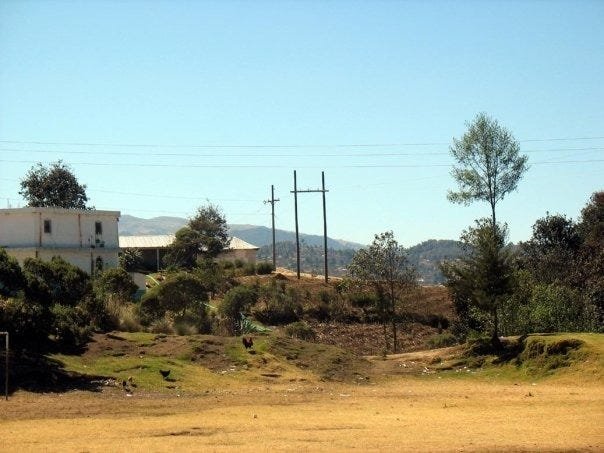
A local teacher had the keys and was happy to invite me inside. I saw where my bed had been. Our kitchen table. The patched hole from the lightning strike. It didn’t take long to see what there was to see. So I walked around back, to the rutty soccer field lined on the far side by eucalyptus trees. I looked up on the hill by the intersection that gave the village its name. There stood three utility poles.
I took a picture of them. They reminded me of something—something I didn’t want to forget.