The Man in the Pew
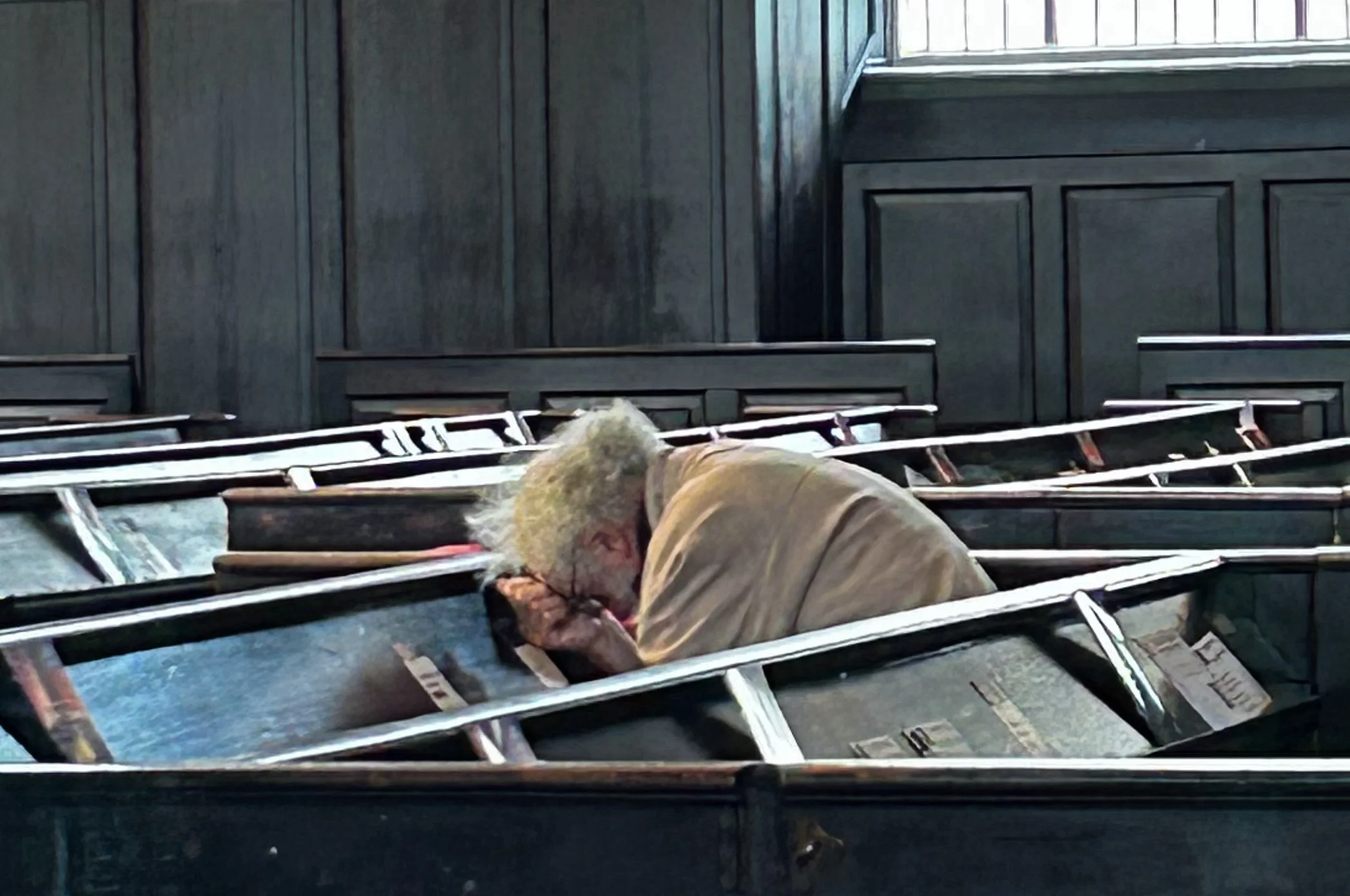
“I’m 99% sure it’s him.”
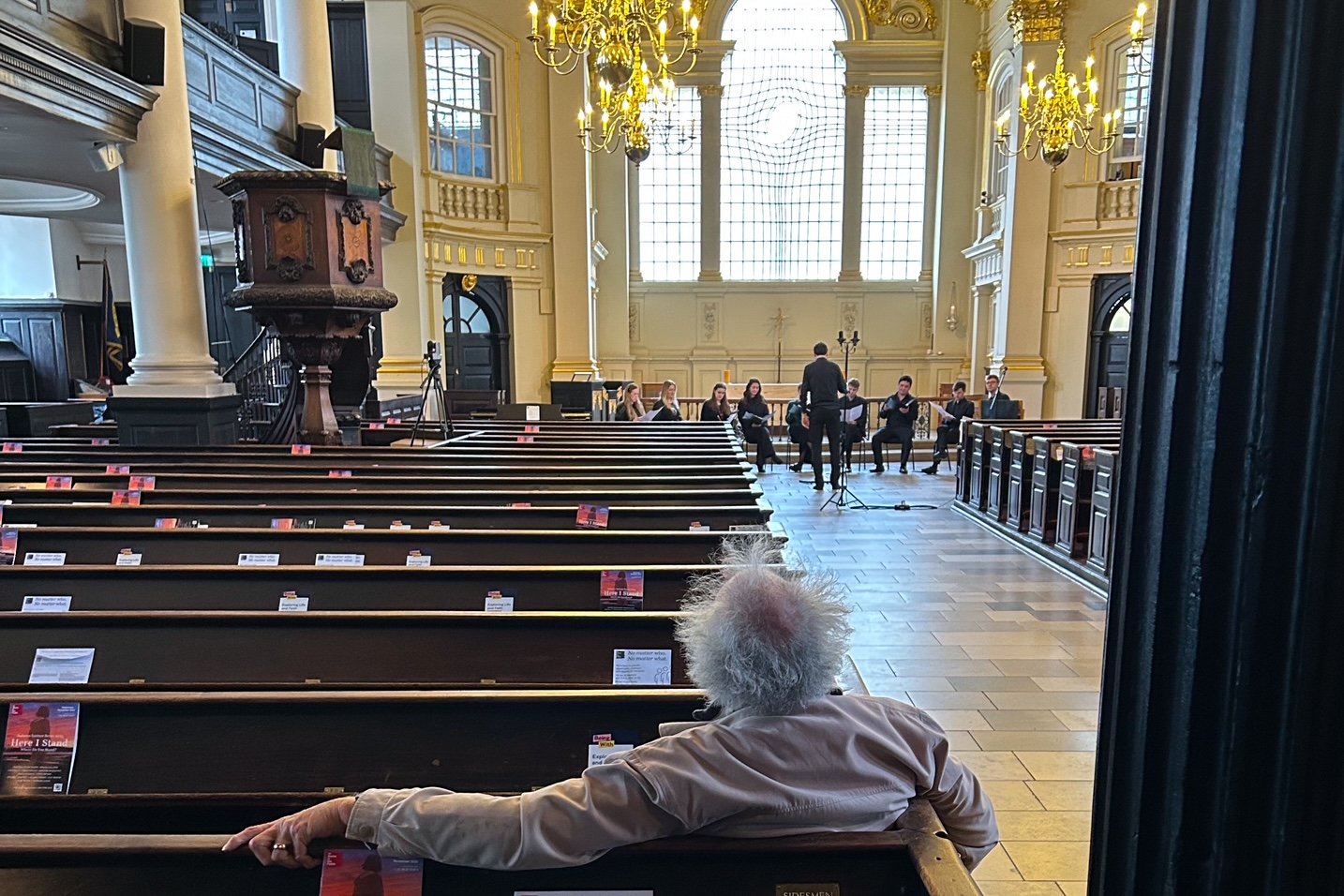
L. whispers it, standing there in the back of the church, pointing his chin at the man in the second-to-last pew. I turn, taking a couple steps to my left, craning my neck for a better view.
With a shock of snow-white hair and a beige rain jacket, there’s no doubt about it. It’s him. That old soul, ancient as an oak. He strains forward, the man in the pew, head in hands. I can’t see his face, but the hair is alive, somehow—charged and glimmering. He’s in considerable anguish, too, as if he carries the weight of the world.
Meanwhile, bathed in the light of a warped and radiant cross,¹ choral voices intone:
Give us this day our daily bread
And forgive us our trespasses
As we forgive them, as we forgive them
That trespass against us²
It’s a Thursday in October, late morning. Out in the rain-soaked plaza, four bronze lions guard a granite column erected to commemorate a decisive victory in battle. But here, in the church, winning is the furthest thing from anyone’s mind.
For ten years the man in the pew struggled to hold together a global communion hell-bent (it would seem) on tearing itself apart. No one was happy with the choices he made—almost nobody. One gut-wrenching “compromise” after another, all in a losing effort to keep the family together, to keep the discordant band intact. And now, with news still fresh of the latest proclamation of divorce, the man in the pew pours forth his lament. A lament which is also, of course, a love song.³
The chorale finishes its rehearsal of “The Lord’s Prayer.” Black-clad singers turn the page, shift in their seats. The man in the second-to-last pew lifts his head, dropping folded hands into his lap. Mediated light from the warped cross finds his face, and all at once we realize: it’s not him. It’s not the archbishop.
The eyebrows are all wrong.
The man in the pew is merely a man in the pew, anonymous to everyone but God, weeping silently and alone. The chorale starts into a piece from the Beatitudes. We linger a moment longer. Then we slip out the door and into the rain.
Notes
¹ A reference to East Window (2008), designed by Shirazeh Houshiary for St Martin-in-the-Fields. Of this “warped cross,” Vivien Lovell writes: “Here, abstraction and representation merge into an iconic whole that invites contemplation. Light illuminates the ellipse at its centre as daylight falls outside. Light catches the etched marks in the glass; the interior of the church and the exterior world are reunited in this extraordinary artwork.”
² Lucy Walker’s evocative choral piece is here, recorded with St Martin’s Voices. More about her original composition here.
³ “Every lament is a love-song.” – Nicholas Wolterstorff, Lament for a Son